Home page
Quantum computer is useless
IBM useless protein molecules
(Fig.1) Today's quantum computers are impractical, too error-prone to give right answers, cannot correct errors.
The recent IBM's three researches' quantum computer advantage is overhyped fake news, like IBM's constant lies.
This or this-lower-Next steps say -- Useless fake quantum advantage
"it's definitely the case that none of these algorithms are useful in any real sense. Even those that model the behavior of quantum systems use incredibly simplified models that don't reflect any real-world systems."
This or this-This is scientific quantum advantage.. says -- Useless research
"These three papers demonstrate quantum advantage for structured random circuit sampling (= just outputting random useless numbers ),... None demonstrates an end-to-end production workload or a commercially useful speedup over the best available classical workflow."
This or this or this-12th, 14th-paragraphs say -- Impractical researches
"The result is still a computing benchmark rather than a useful scientific or commercial calculation"
"IBM's two other demonstrations.. their claims are less conclusive"
This or this-Key insights and 8th-last-paragraph says -- No advantage
"commercial utility remains years away."
"Whether these demonstrations achieved quantum advantage is unclear"
Because quantum computers are impractical, too error-prone to give right answers, cannot factor even 21, much less outperform today's errorless classical computers.
The IBM's 1st research just output useless random numbers called "random circuit sampling (= RCS ) by almost randomly flipping their 70 qubits (= one qubit takes only 0 or 1 value, this or this-2nd-paragraph ).
This or this-8th-paragraph says -- Just output random useless numbers
"The experiment used a structured form of random circuit sampling (= useless random number generator, this or this-3rd-paragraph ), a benchmark in which a quantum computer generates patterns that become increasingly difficult for a conventional machine to simulate"
This or this-8th-last-paragraph say -- Useless random sampling
"it generated a certain pattern of random numbers in a test called Random Circuit Sampling."
This or this-5th-paragraph say -- IBM output useless random numbers
"the researchers modified a popular approach for demonstrating quantum advantage called random circuit sampling, which was the basis of the first (since contested) claim of quantum advantage by Google in 2019. This involves running a randomly generated sequence of quantum gates on a quantum processor, recording the output and then getting a classical machine to replicate the results (= unseen parallel-world-random numbers )."
This-IBM-paper-p.2-right-2nd-paragaph (or p.16-Fig.S1-random qubits' layer ) says
"We begin with a random Clifford circuit (= randomly flipping qubits by some random phases with No useful computation ),"
Like Google's and China's fake quantum supremacy, they baselessly claim these 70 qubits of the IBM quantum computer can take (unrealistic unseen) 270 quantum superposition or parallel-world states to get random numbers, which are hard for a classical computer with a single real world to emulate ( this or this-5~8th-paragraphs ).
This or this-8th-paragraph says -- Unreal parallel worlds
"Superpositon: A qubit can be in a state of both 0 and 1 simultaneously (= No evidence ). This means n qubits can represent up to 2^n states, allowing quantum computers to explore multiple possibilities at once (= for outputting random useless numbers, this or this-9th-last-paragraph through unreal parallel worlds ? this or this-p.11~p.13 )—unlike traditional computers"
↑ A classical computer can get random numbers much faster if it is not forced to imitate those unrealistic quantum parallel-world states, so No quantum computer advantage from the beginning, and this is why all these quantum advantage researches are useless.
Furthermore, today's quantum computers are impractical, too error-prone (= noisy ) to get right answers, just giving random meaningless numbers with a lot of errors. ← Today's quantum computers unable to give right answers mean No quantum advantage nor supremacy, contrary to a lot of fake news.
This or this-Challenges and future work (2026) say -- Erroneous quantum
"The work (= Google's latest Willow quantum computer ) does Not eliminate quantum errors, nor does it demonstrate a fully fault-tolerant quantum computer capable of solving commercially important problems."
↑ So the current fake quantum computer advantage or supremacy researches see only speed, ignoring the fact that their quantum computers gave only wrong erroneous answers with No ability to correct errors ( this or this-middle-No error correction yet ).
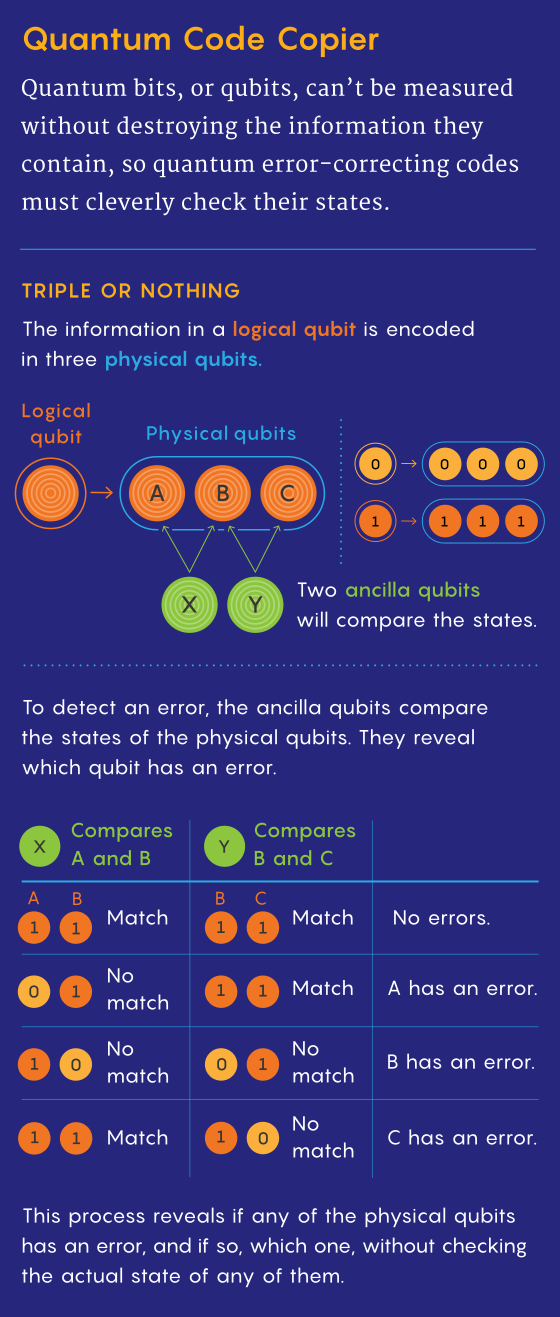
IBM used 27 ancilla qubits to indirectly detect the remaining 70 qubits' errors, and almost all their (random sampling) computing results were discarded due to errors in the illegitimate post-selection cheating (= about 860 sampling results were discarded due to errors in each total 861 random sampling attempts ).
Even after discarding almost all (= 860/861 ) computing results, IBM quantum computer was estimated to still show about 72% error rates (= 0.28 fidelity, fidelity = 1 - error rate, this or this-p.59, this-p.3(or p.2)-1st-paragraph )
This or this or this-The fidelity numbers.. says -- Illegitimate post-selection
"a post-selection acceptance rate of about 0.059%, or roughly one accepted sample per 1,700 circuit executions (= 1699 results were discarded per 1700 runs ). The paper separately reports an 860-fold reduction"
↑ So almost all (random-sampling) results were discarded due to errors that cannot be corrected, which is impractical, cannot validate real quantum computer advantage.
This-p.3-2nd-paragraph says -- Discard, Not correct errors
"which means that detected errors cannot be uniquely identified and
corrected. We must therefore rely on post-selection to find and discard cases where an error
occurred"
↑ Of course, the actual error rates cannot be known from this IBM outputting random meaningless numbers. They just roughly estimated the error rates from the exact classical computer's simulation of illusory parallel-world random numbers (= by classical tensor network method, this-p.4-2~p.5 ) + error-detection rates (= by ancilla qubits ) with No verification.
This or this-10~12th-paragraphs say -- Fake verification
"IBM.. by starting with a circuit that could still be simulated conventionally. They then inserted T gates (= changing a qubit by some phase ) that made the calculation much harder while retaining checks capable of detecting errors (= by ancilla qubits ) as it ran.
"That allowed the researchers to estimate the fidelity (= 1 - error rate ) of the difficult calculation directly.." ← False, it's impossible to know true error rates of random meaningless numbers
"The result is still a computing benchmark rather than a useful scientific or commercial calculation." ← Useless quantum computers just outputting erroneous random numbers
This or this or this site on this IBM research ↓
13th-paragraph says -- Just 70 qubits
"IBM and University of Chicago researchers encoded a 70-qubit circuit across 97 physical qubits (= far from millions of qubits required for a practical computer )... while 27 ancillas (= qubits indirectly detecting errors ) measured checks that could reveal errors."
16th-paragraph says -- 72% error rate
"establish a fidelity lower bound of 0.284 (= 72% error rate, this-6th-paragraph )... Fidelity measures how closely the state produced by the machine matches the state it was supposed to produce. "
19th-paragraph says -- 860 results in total 861 were discarded
"The circuit detects errors and throws out affected runs. It does not correct errors in real time. This error-detection method also comes at a cost.... postselection ( this-p.3-2nd-paragraph ) reduced the effective sampling rate by a factor of 860 (= 860 results out of 861 random-sampling results were discarded due to errors detected without error correction )"
7th-paragraph says -- 72% error rate
"among the execution results that were not rejected as errors, they confirmed that more than 28% had faithfully completed the computation. The lower bound of fidelity was calculated to be 0.284"
9th-paragraph says -- Discard results without correcting errors
"the total number of runs—including those rejected mid-way due to detected errors—ballooned to a full 860 times what it would be under normal circumstances. This is why the figure of "28% completed the computation faithfully" appears low at first glance. The vast majority of the runs are destined to be rejected due to errors"
↑ This-IBM-paper-p.3-Fig.2b shows in 27 ancilla qubits, fidelity (= black line ) was 0.28 in post-selection rate (= blue line ) being only 1/1000, which means almost all results (= 999 results in total 1000 runs ) were discarded due to errors, which still caused high error rate of 72%.
As a result, this IBM research just outputting random useless numbers with a lot of errors cannot prove quantum advantage over today's errorless classical computers.
The other two IBM researches are also useless, just almost randomly flipping qubits (= allegedly through unfounded quantum parallel worlds hard for a classical computer's single real world to simulate ), which caused a lot of errors (= which errors cannot be corrected ) with No real quantum advantage.
Quantum computers cannot correct errors, so they used illegitimate error mitigation (= this, this = useless ), which just roughly guessed answers from the exact classical computer simulating results and artificial error model.
↑ This illegitimate quantum error mitigation is impractical, cannot correct errors nor be applied to practical large problems, so No quantum computer advantage.
This or this -3rd-paragraph says - No error correction
"Quantum error mitigation techniques try to reduce the impact of noise in quantum computations. They generally do Not completely remove it."
This or this or this-3rd-last-paragraph says -- No quantum advantage
"However, regarding the Qedma and Algorithmiq studies, he pointed out that "neither paper's authors explicitly claim quantum advantage themselves ( this or this-14th-paragraph )."
20th-paragraph says -- Useless tasks
"For the second paper, Qedma used IBM’s processors to simulate a two-dimensional Floquet Ising model, which describes how a model magnet behaves when it is hit with a repeating sequence of external pulses."
21th-paragraph says -- Error-prone quantum computer
"These simulations covered systems with both 51 and 74 qubits (= useless )... The error-mitigated quantum calculation, however, continued to show persistent oscillations. ← this-p.6-Fig.3a-unmitigated Quantinuum-IBM-Helio results (= original error-prone quantum computer's results ) showed erroneous results different from the exact classical computer's theoretical prethermal value."
26th-paragraph says
"Meanwhile, for the third paper, Algorithmiq and IBM used 56 qubits to measure an operator Loschmidt echo (= giving almost random useless numbers, this-p.14-lower-b. )"
29th-paragraph says -- Illegitimate error mitigation
"and injected additional noise. After error mitigation, the results remained consistent." ← IBM's error-prone quantum computers' original unmitigated results always gave wrong answers ( this-p.3-Fig.1(d), p.5-Fig.2 ).
↑ Fake quantum computer advantage relying on illegitimate error mitigation (= which cannot correct errors, this or this-Error mitigation technique ) roughly guessing answers (= they called this roughly-guessed incorrect numbers 'verified' quantum advantage wrongly ) from ad-hoc error model and exact classical computer's simulation (= No real quantum computation ).
This and this-2nd-paragraph says -- Mitigate, Not correct errors
"While error mitigation techniques offer some improvement, they are insufficient for achieving the fault-tolerant application-scale machines needed for practical, large-scale quantum algorithms."
This-p.1-right-2nd-paragraph says -- Cannot correct errors
"quantum
error correction is generally not possible on them.... Quantum error
mitigation methods aim to reduce the effects (e.g. magnitude)
of system errors rather than completely eliminate them... which utilize classical
post-processing approaches (= instead of quantum computer's useless error correction ) to mitigate errors"

Feel free to link to this site.