Home page
Quantum computer is hopeless
(Fig.1) IBM quantum computers were outperformed by classical computers.
The recent overhyped news claimed IBM quantum computer called "eagle" with (just) 127 qubits might show quantum utility by mitigating their errors.
But actually, to jump to the conclusion, this IBM quantum advantage or utility, which claim was wrong from the beginning, turned out to be fake even officially.
Classical computers easily outperformed IBM 127-qubit quantum computer, even in a very unfair condition unfavorable to classical computers.
This 9~10th-paragraphs say -- Classical superior.
"By adopting a (classical) tensor network approach, we can perform a classical simulation that is significantly more accurate than the results obtained by the quantum device."
This p.1-left-lower says -- No quantum advantage
"IBM team simulated the
dynamics of .. (useless) Ising model (= just manipulating qubits in some ways ) on a 127-qubit...
However, and unlike originally thought,
they are still far from any sort of quantum advantage"
First of all, today's quantum computers including IBM are too error-prone to give right answers, and error corrections of quantum computers is impossible (forever).
This 1st-paragraph says -- Error-prone quantum
"Despite steady improvements in quantum computers, they're still noisy and error prone, which leads to questionable or wrong answers. Scientists predict that they won't truly outcompete today's classical supercomputers for at least five or 10 years, until researchers can adequately correct the errors" ← quantum error correction will never happen
The impossibility of quantum error correction shows there is No quantum advantage nor supremacy from the beginning.
This 1st-paragraph says "quantum computing, but so far it has Not surpassed conventional computers" ← No quantum advantage
This-3rd-paragrapg says "Quantum computing today provides No tangible advantage over classical computing in either commercial or scientific applications."
This 1~2nd-paragraphs say "pouring billions of dollars into quantum computing, despite the technology still being years away from practical applications" ← No quantum utility.
Real quantum advantage or supremacy needs more than millions of qubits ( this-summary, this-4th-paragraph ), which is far more than IBM's just 127 qubits (= one qubit can take only 0 or 1 values ).
(Fig.2) Today's quantum computers are too error-prone to give right answers

Contrary to a lot of overhyped fake news, quantum computers (based on fantasy parallel-world calculation speed-up ) are impractical forever, too error-prone (= noisy ) to give right answers ( this-p.1-right-1st-paragraph, this-3~5th-paragraphs ).
Even the latest IBM, Google.. quantum computers still cannot get right answers (= still cannot factor even 21 ) nor correct errors, which means the overhyped quantum supremacy is fake.
This or this-Challenges and future work (2026) say -- Erroneous quantum
"The work (= Google's latest Willow quantum computer ) does Not eliminate quantum errors, nor does it demonstrate a fully fault-tolerant quantum computer capable of solving commercially important problems."
Quantum computers cannot correct errors (= quantum error correction is impossible forever ).
So physicists start to rely on illegitimate quantum error mitigation (= QEM ).
This illegitimate quantum error mitigation method can Not completely correct errors nor get useful right answers ( this or this-p.36 ), which is why quantum computers can Not factor even the simple 21.
This or this -3rd-paragraph says No error correction
"Quantum error mitigation techniques try to reduce the impact of noise in quantum computations. They generally do Not completely remove it."
This or this-Error mitigation technique says
"Error mitigation does Not prevent or correct errors "
This-p.2-right-3rd-paragraph says --Mitigate, Not correct errors
"That is to say QEM (= quantum error mitigation ) will only reduce the
effective damage due to noise.... but when
we zoom into each individual circuit run, the circuit noise (= error )
level remains unchanged or even increases."
This ad-hoc quantum error mitigation tries to roughly guess right answers from the error-prone quantum computer results with the help of classical computers instead of the (useless) quantum computers correcting errors.
This-p.1-right-2nd-paragraph says -- Cannot correct errors
"quantum
error correction is generally not possible on them.... Quantum error
mitigation methods aim to reduce the effects (e.g. magnitude)
of system errors rather than completely eliminate them... which utilize classical
post-processing approaches to mitigate errors"
↑ Relying on classical computers instead of today's error-prone quantum computer's (parallel-world) faster calculations means this error mitigation cannot realize real quantum computer advantage ( this or this-Why error mitigation has limits.. ).
There is No guarantee that their artificial error models based on measuring the current error-prone quantum computer results can guess (or extrapolate ) right answers ( this-p.1-left-2nd-paragraph, this-p.1-left-2nd-paragraph ).
This-p.1-right-1st~2nd-paragraphs say -- Useless error mitigation
"In QEM (= quantum error-mitigation ), the correct result of a calculation is
generally estimated by post-processing the output
from multiple quantum circuits using a classical computer.."
"QEM cannot fundamentally suppress errors in the
quantum state"
This or this-2nd-last-paragraph says -- Illegitimate error mitigation
"Some researchers are less optimistic about the potential of noise mitigation, and expect that only quantum error correction will enable calculations that would be impossible on even the largest classical supercomputers" ← Ad-hoc quantum error mitigation cannot get real quantum advantage.
They need to sample a lot of those error-prone quantum computing results to roughly guess right answers, which is impractical, taking too much time, so cannot be used for practically-large problems.
This or this-2nd-paragraph says -- No fault-tolerant
"they (= quantum error mitigation ) are insufficient for achieving the fault-tolerant application-scale machines needed for practical, large-scale quantum algorithms."
This-p.19-C. says -- Impractical, unscalable
"This noise (= error ) mitigation has two shortcomings. The first one
is that it does Not remove all errors, because some errors are undetectable... The second and more important shortcoming of this noise mitigation is that it is not scalable"
(Fig.3) There is No evidence of the error-prone IBM quantum computer using quantum superposition or parallel universes for (fake) quantum advantage
They baselessly claimed IBM 127-qubit quantum computer could utilize (unseen fantasy) quantum superposition or 2127 = 1038 different parallel-universe states (= one qubit can allegedly take 2 states of 0 and 1 × 127 qubits ) during qubit operation ( this 7th-paragraph, this 12th-paragraph ).
This or this 15~17th-paragraphs say -- Quantum parallel worlds ?
"In fact, exactly simulating all 127 entangled qubits on a classical computer would require an astronomical amount of memory. The quantum state would need to be represented by 2 to the power of 127 (= 2127 ) separate numbers. That's 1 followed by 38 zeros (= 1038 superposition or parallel world states )"
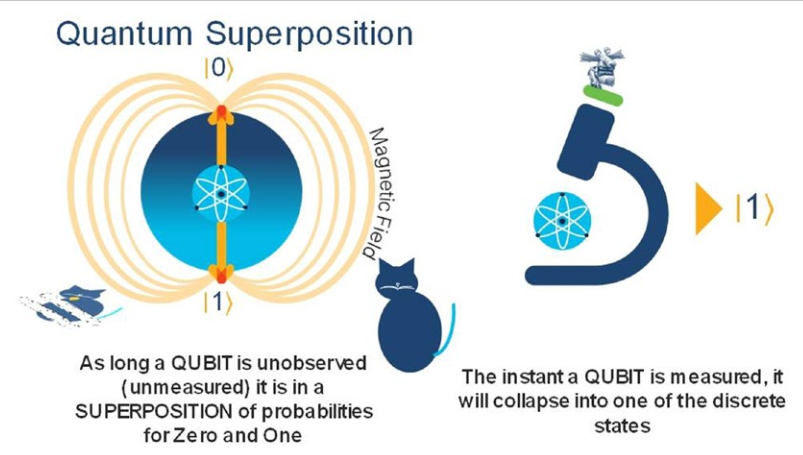
↑ This quantum superposition or parallel universes on which the quantum advantage relied are baseless, lacking evidence, because they can observe only one single value or a single universe (= multiple superposition states or parallel universes are unobservable ), when measuring the qubits' results, which is called "superposition collapse".
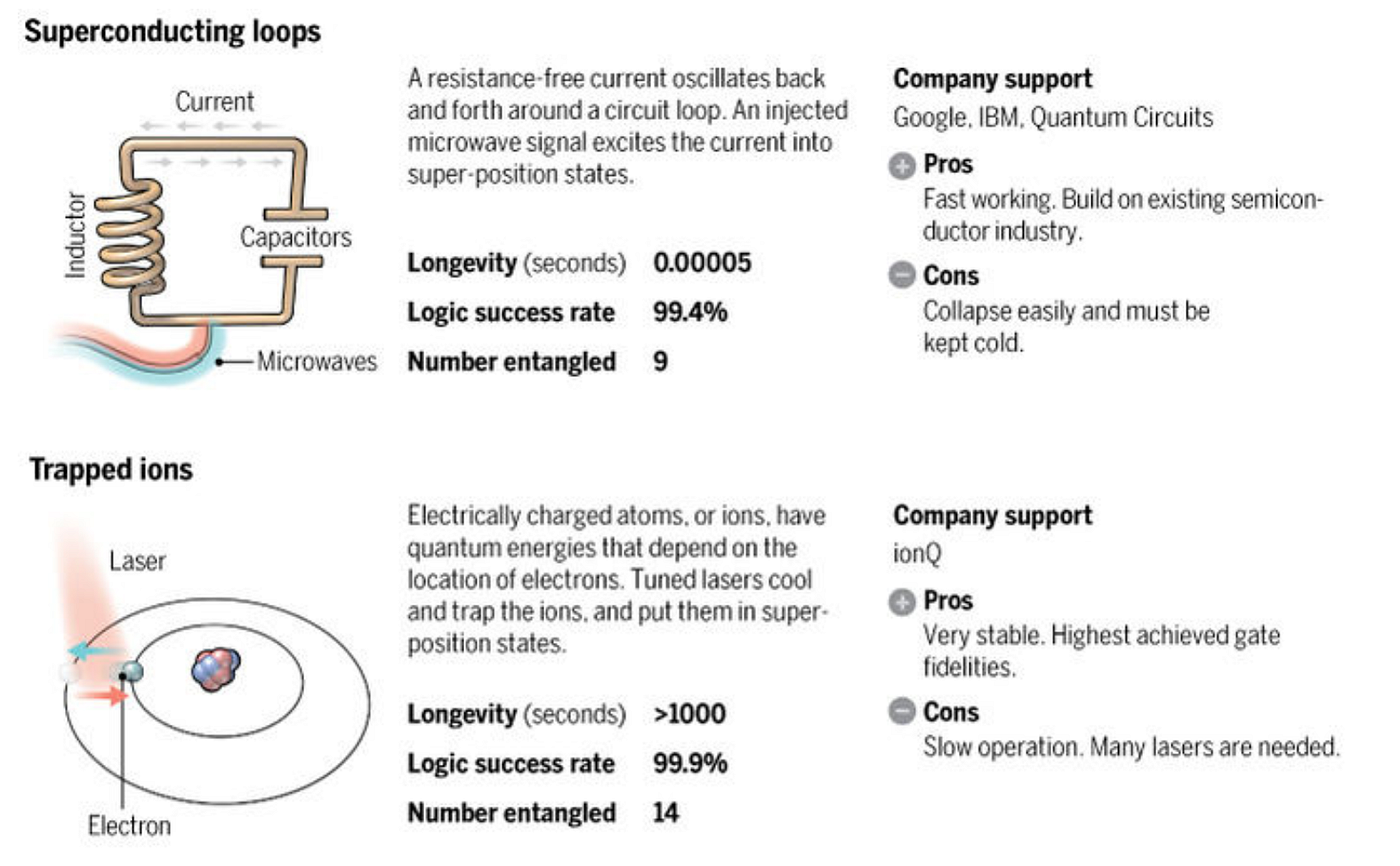
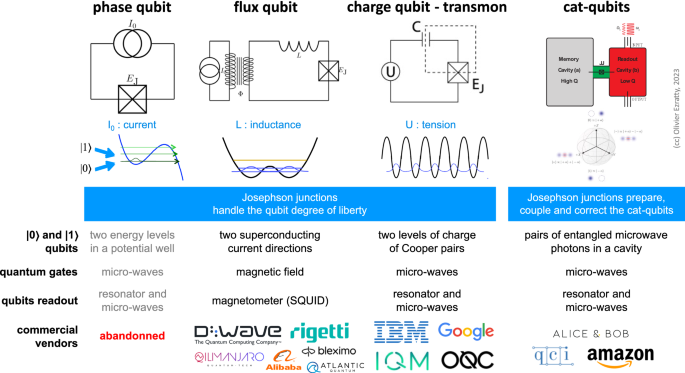
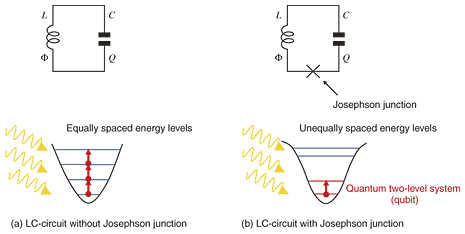
IBM used a (classical) superconducting circuit called transmon qubit whose amount of electric charge current represented each qubit 0 or 1 (= or the middle of 0 or 1 is called superposition irrelevant to quantum mechanics ) manipulated by (classical) microwave light ( this p.2 ), which has nothing to do with (fantasy) quantum parallel worlds.
The unseen quantum superposition or a (unrealistic) dead-and-alive cat state just means probabilities with which qubits take different states when measured ( this middle, this p.3~7 ).
Proving the real quantum advantage or supremacy based on the (unseen) quantum superposition-simultaneous calculations requires the quantum computers to get right answers far faster than classical computers.
But today's quantum computers cannot get right answers due to too many errors and impossibility of quantum error correction. ← so No evidence of quantum advantage nor supremacy.
↑ Even when a classical computer was unfairly forced to imitate these unfounded quantum superposition or 2127 unrealistic parallel worlds, the classical computer could outperform the quantum computer, using classical tensor network method imitating qubits' (illusory) superposition.
This site's 7~8th-paragraphs say -- No quantum advantage
"To fully represent the wave function of these qubits would require 2^127 = 10^38 numbers,.."
"his colleagues solved the problem on a classical computer with greater accuracy than achieved using the quantum one." ← Quantum advantage was officially disproved.
(Fig.4) IBM quantum computer always gave wrong values, while classical computer always gave right answers. ← No quantum advantage

The error-prone IBM quantum computer tried to rely on illegitimate error-mitigation (= using precise classical computer ), where physicists paradoxically increased errors and obtained more wrong answers in 127-qubit quantum computers, and tried to guess right answers by using classical computers and ad-hoc error-mitigation model through extrapolation.
This 3rd~4th-paragraphs say -- No error correction
"While quantum error correction can theoretically address these issues, it demands significant resources, making it impractical for near-term quantum devices."
"Error mitigation in quantum computing is a method used to correct mistakes caused by noise in the system using classical computing techniques" ← No quantum computer advantage due to reliance on classical computers.
This or this 10th-paragraph says -- Noisy quantum computer
"Paradoxically, IBM researchers controllably increased the noise (= errors ) in their quantum circuit to get even noisier, less accurate answers and then extrapolated backward to estimate the answer"
This IBM research paper p.3-Fig.2 shows IBM 127-error-prone qubits just gave the unmitigated wrong values (= green, red circles ), which were completely different from the ideal classical computer's right answers or values whose errors were mitigated by classical computers (= blue circle or gray dotted line )
IBM's alleged largest 1121-qubit (or Chinese 504-qubit = publicity stunt ) quantum computer lacking detailed information is useless, still far from millions of qubits required for a practical quantum computer, and even worse than the far-less qubits ( this 3rd-paragraph ).

Feel free to link to this site.