Home page
Quantum computer is dead.
Quantum annealing is
scam
D-Wave cannot compute proteins
Hybrid QAOA is useless
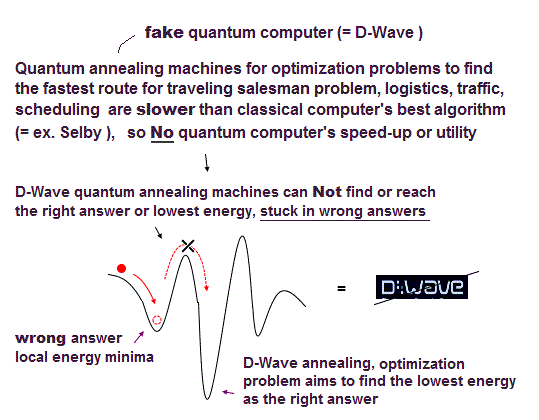
(Fig.1) Quantum annealing or D-Wave (= Not a real quantum computer ) for optimization problems is useless, showing No quantum advantage.
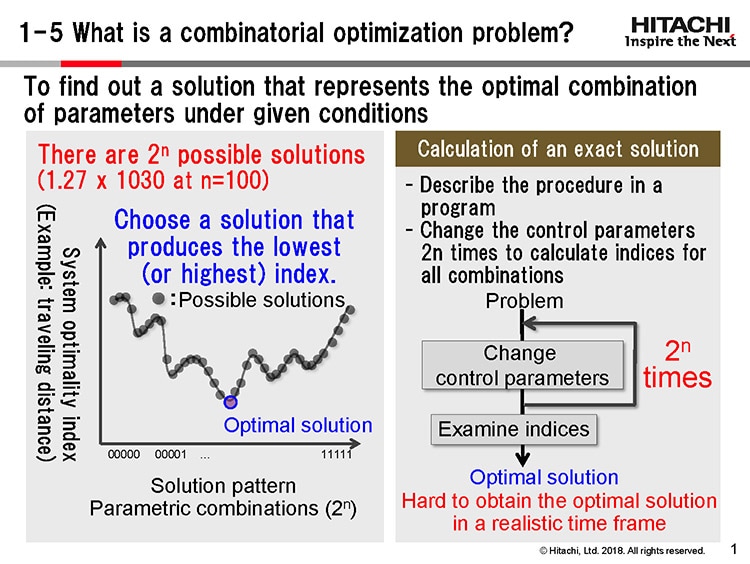
Quantum annealing machines (= Not a real quantum computer ) or quantum adiabatic computers are said to solve optimization problems finding the lowest energy states ( this p.2-4 ) encoding answers such as the shortest route, efficient scheduling, logistics, traffic flow under given conditions (= input some parameters ).
↑ So the quantum annealing or D-Wave, which just settles down to the lowest-energy state, cannot compute anything, and almost always gives the wrong answers stuck in one of many local energy minima.
This-p.10-2nd-last-paragraph says -- Erroneous quantum annealing
"However, even for these two small problems, we did not achieve the feasible solution. From
this, we can conclude that quantum annealers are too small and too prone to errors,"
In fact, quantum annealing or D-Wave is useless, cannot solve even simple optimization problems such as traveling salesman problems (= TSP ) finding the shortest route passing multiple points due to the quantum annealers' errors.
This or this-5th-last-paragraph says -- No quantum advantage
"In fact, it hasn't been proved yet that quantum annealing gives an advantage over classical optimization algorithms. One of the reasons is because error correction protocols have not been developed"
This or this-Abstract says -- No traveling salesman problem
"The traveling salesman problem is a well-known NP-hard problem in combinatorial optimization... It is found the quantum annealer can only handle a problem size of 8 or less nodes (= less than 8 points passed ) and its performance is subpar compared to the classical solver both in terms of time and accuracy"
This-p.1-right-1st-paragraph (2026) says -- Useless quantum annealing
"Despite these
advances, applying QA (= quantum annealing ) to routing problems such as the TSP (= traveling salesman problem )
remains challenging.... important limitations:.. the approach can only handle very small instances"
All the overhyped quantum advantage claims in quantum annealing or D-Wave are fake, caused by unfair comparison with deliberately-chosen bad classical computing methods.
Good classical computing methods such as Gurobi and Selbi can easily outperform the error-prone quantum annealing or D-Wave ( this or this-6th-paragraph ).
This or this-3rd-paragraph says -- Classical beats quantum
"Furthermore, on every instance tested so far, Selby's (classical) annealing algorithm outperforms the D-wave machine, RUNNING ON A LAPTOP."
15th-paragraph says -- Various classical methods
"In the Google paper, they discuss two classical algorithms that do match the asymptotic performance — and one of them beats the real-world performance — of the D-Wave machine. So besides simulated annealing,.. One of them is quantum Monte Carlo, which is actually a classical optimization method"
19th-paragraph says -- Classical Selby beats D-Wave
"What the Google paper finds is that Selby’s algorithm, which runs on a classical computer, totally outperforms the D-Wave machine on all the instances they tested."
This or this-2nd-last-paragraph says -- No quantum annealing advantage
"The VW research team also notes that their primary goal is.. not to prove supremacy over every existing classical clustering algorithm"
D-Wave and many corporations across the world are cooperating with each other and try to make their useless quantum annealing look useful for practical application such as logistics, manufacturing, scheduling, traffics.. just to raise their stock price by hiding detailed methods.
↑ All these (fake) practical application of quantum annealing was conducted by classical computers doing some "quantum" algorithm disguised as hybrid quantum computers (= hybrid solvers, this or this-p.27-7.-NTT, this-3rd-paragraph-Mastercard, this-Insider brief -Ford ).
This or this-report debunked D-Wave's lie (2025) ↓
p.1-2nd-paragraph says -- Useless D-Wave
"a wide range of D-Wave customers we interviewed in key verticals like logistics, manufacturing, and
pharmaceuticals reported seeing zero benefit from the technology"
p.3-3rd-paragraph says -- Hybrid = classical computer
"the hybrid approach is driven
“almost entirely” by advanced classical algorithms, with the inclusion of quantum processing
representing little more than a marketing gimmick."
This or this on D-Wave, AT&T hiding detailed quantum methods ↓
2nd-paragraph says -- Hide crucial information
"The scale of the problem, the classical computing environment used for comparison, and the quality of the resulting solution have Not been disclosed."
4th-paragraph says -- No quantum computer advantage
"there's No information on the gap from the optimal solution, reproducibility, or a comparison against what a purely classical computation would produce given the same amount of time... but it does Not prove quantum advantage over classical computing."
D-Wave never disclosed roles of quantum and classical computers in their hybrid computers, because their hybrid computers are just classical computers.
This or this-paper on back-box D-Wave's deceptive hybrid computing (2026) ↓
p.2-4th-paragraph says -- Impractical quantum annealing
"Although QAs (= quantum annealing ) are advancing rapidly, they are not yet capable of addressing problems at real-world scale. To overcome these limitations, hybrid approaches have emerged"
p.13-1st-paragraph says -- D-Wave hides details
"as the black-box nature of D-Wave’s
hybrid solver limits insight into how computational effort is allocated between its classical
and quantum components."
p.18-1st-paragraph says -- No hybrid quantum advantage
"Under strict runtime limits, the hybrid solver achieved solution quality comparable to (classical) Gurobi,.. Whether this advantage persists under relaxed time limits
or full optimality conditions remains an open question" ← Still No D-Wave's hybrid computing advantage.
D-Wave and many corporations often claim quantum annealing (= fake quantum computers ) has already been used for some practical application in the real world, which is a lie.
You can easily know this practical quantum annealing is a lie from the fact that D-Wave has just increased its net loss with No profit from their impractical quantum annealing machines ( this or this-8th-paragraph ).
D-Wave and many corporations try to disguise ordinary classical computers as "hybrid quantum computers" to make their useless quantum annealing look useful in the real industry.
These hybrid quantum computers, which are just classical computers, cannot outperform today's good classical computing methods.
Insider brief says -- Classical beats quantum annealing
"an algorithm that outperforms leading quantum annealing processors in speed and accuracy while running on standard computers."
3rd-paragraph says -- Classical beats hybrid D-Wave
"VeloxQ1 (= classical computing ) was evaluated against quantum hardware platforms, including D-Wave Advantage and Advantage2,.. It was also tested against hybrid quantum-classical systems,.. VeloxQ1 consistently outperformed its competitors in both accuracy and computational speed."
This or this paper on No hybrid quantum computer advantage ↓
p.1-Abstract (2025) says -- Useless D-Wave hybrid
"the performance of D-Wave's hybrid solver against that of
industry-leading solvers such as CPLEX, Gurobi (= classical computer ),.. While D-Wave can solve such problems, its performance has not yet
matched that of its classical counterparts"
p.12-3rd-paragraph says -- Classical beats hybrid quantum
"Despite various adjustments and reduced problem cases, D-Wave's LeapHybridCQMSolver (= hybrid ) was unable
to surpass Gurobi (= classical ) in terms of computational time or solution qualit"
p.12-2nd-last-paragaraph says -- No hybrid quantum advantage
"D-Wave's hybrid solvers and Advantage quantum
computers currently exhibit competitiveness with classical optimisation algorithms, but this holds true only for
a limited range of problems"
This or this recent published paper (2026) showed No quantum advantage ↓
↑ p.1-abstract says -- No quantum advantage
"We evaluate D-Wave's fast annealing QPU and Hybrid solver against classical simulated annealing (SA) and Toshiba's simulated bifurcation machine (SBM = classical computer, this or this-2nd-paragraph, this or this-3rd-paragraph )" ↓
"For small instances (≤ 250 nodes) with known global optima, Hybrid and SA (= classical computer, this or this-15,19th-paragraphs ) consistently achieve optimal solutions, outperforming the QPU (= D-Wave quantum OPU was inferior )"
"For larger instances, SBM (= classical computer ) and slower SA (= classical computer ) yield superior solutions, while Hybrid and faster SA perform less effectively." ← Even the D-Wave deceptive hybrid quantum machines (= just classical computers ) were inferior.
↑ p.14 says -- D-Wave quantum QPU was worst.
"both simulated annealing (= classical computer ) variants consistently achieved the global optimum,
whereas the QPU (= D-Wave quantum annealing ) produced solutions that were far from optimal (= D-Wave gave only wrong non-optimal values )."
"The instances were too large for the QPU to handle" ← The error-prone D-Wave QPU cannot deal with large problems.
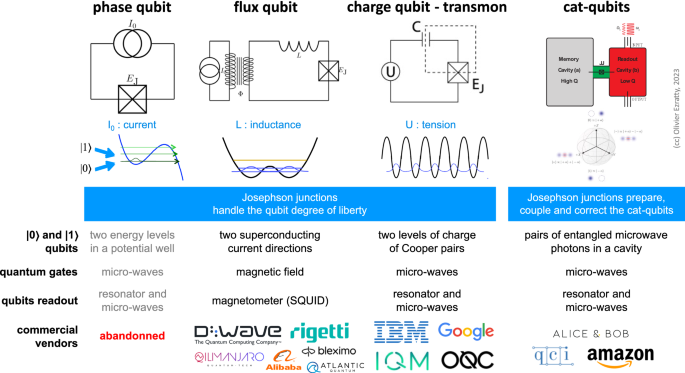
(Fig.2) Classical electric current difference induced by applied magnetic field generates D-Wave's flux qubit-0 and 1 states.
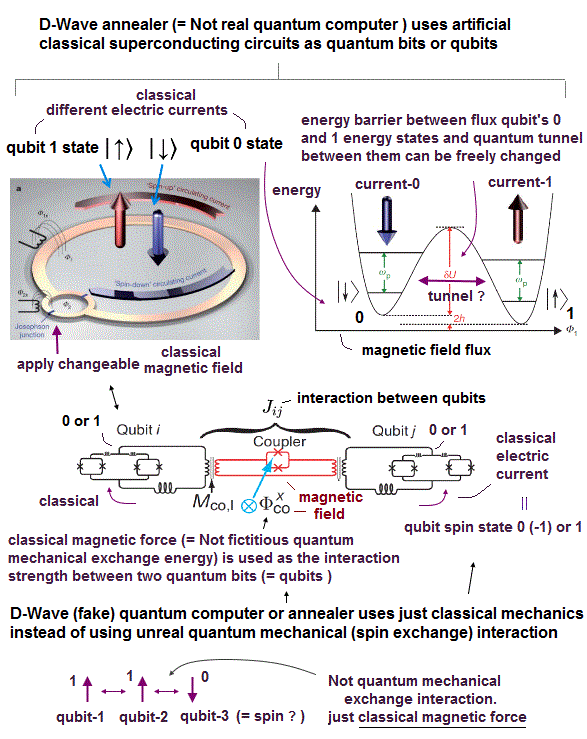
D-Wave annealing machines use the direction of classical electric current flowing through the superconducting circuit as their ( flux ) qubit state 0 or 1. No quantum mechanics is used.
Electron's current tends to be quantized due to the (classical) electron's ( an integer times ) de Broglie wavelength in D-Wave's superconducting flux qubit or circuit that can be manipulated by external magnetic field ( this p.6-7 ).
↑ By adjusting applied magnetic field (= flux ) in qubits (= classical superconducting circuits ) and couplers connecting qubits, D-Wave can optimize the final lowest-energy stable solution.
Quantum tunneling is a realistic classical phenomena (= electric current over only very short distance ) irrelevant to unrealistic quantum mechanical negative kinetic energy
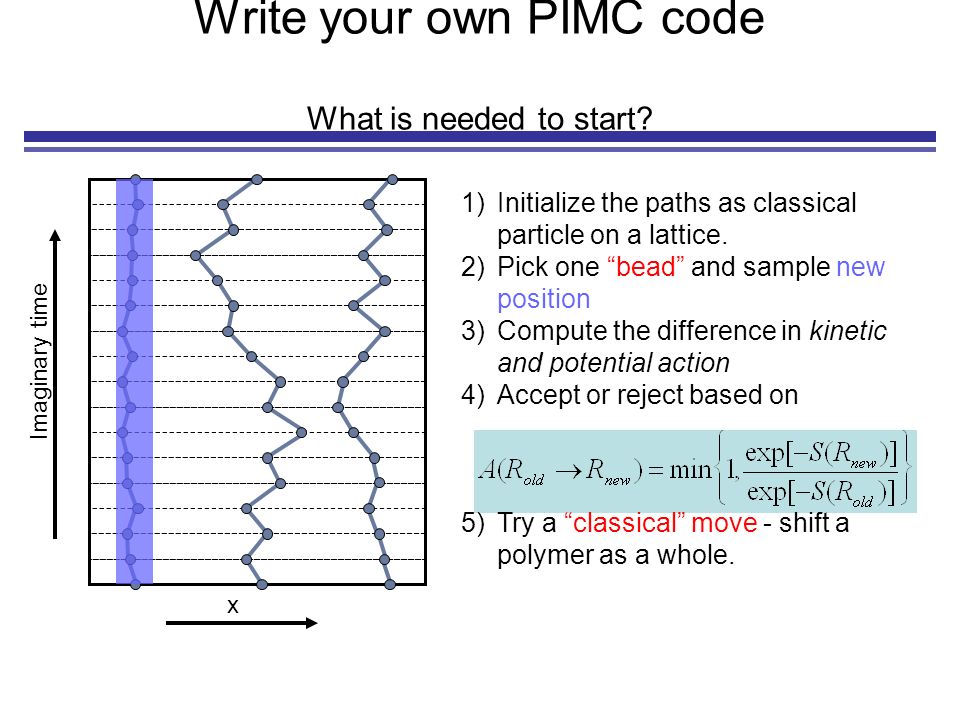
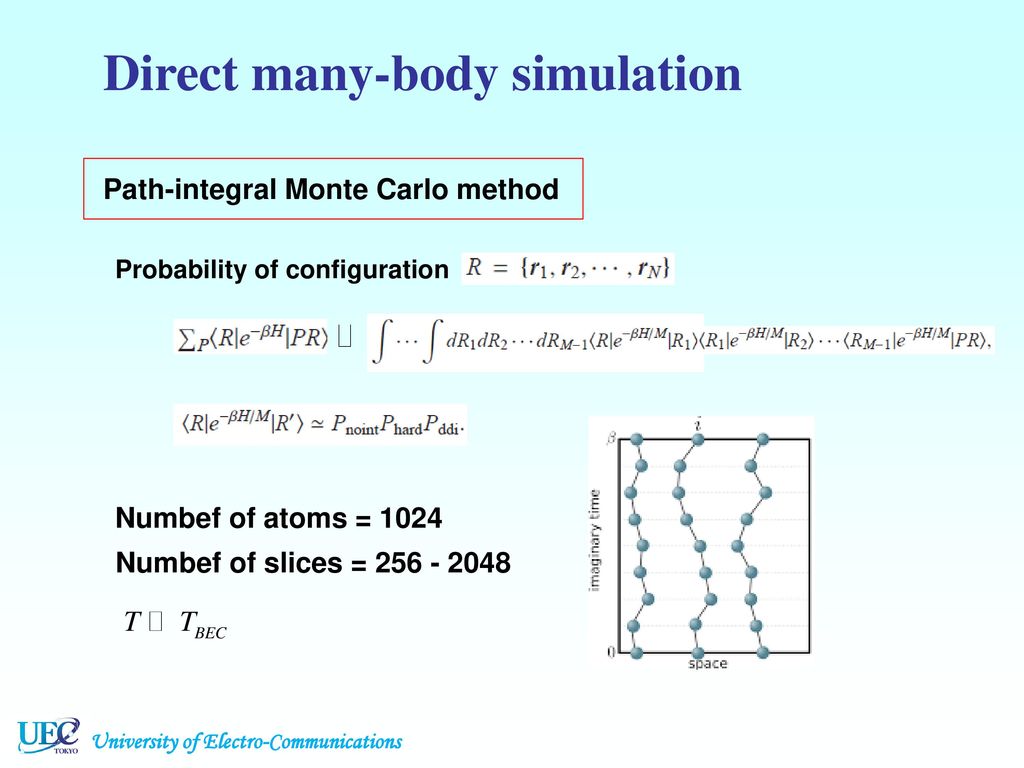
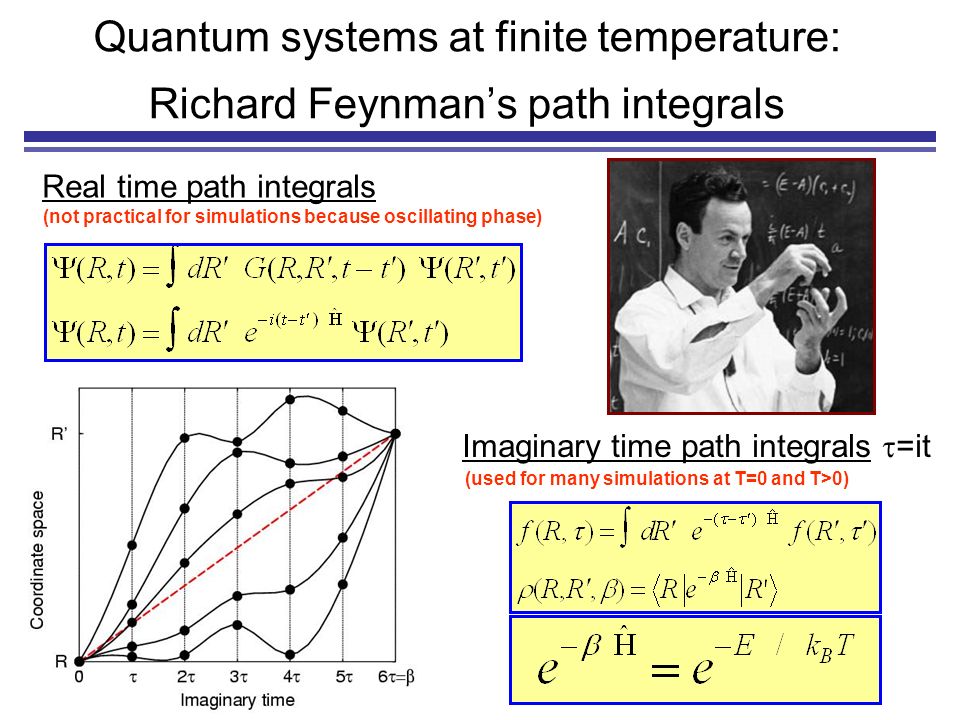
(Fig.3) One of bad time-consuming classical methods called path integral Monte-Carlo (= PIMC ) ↓
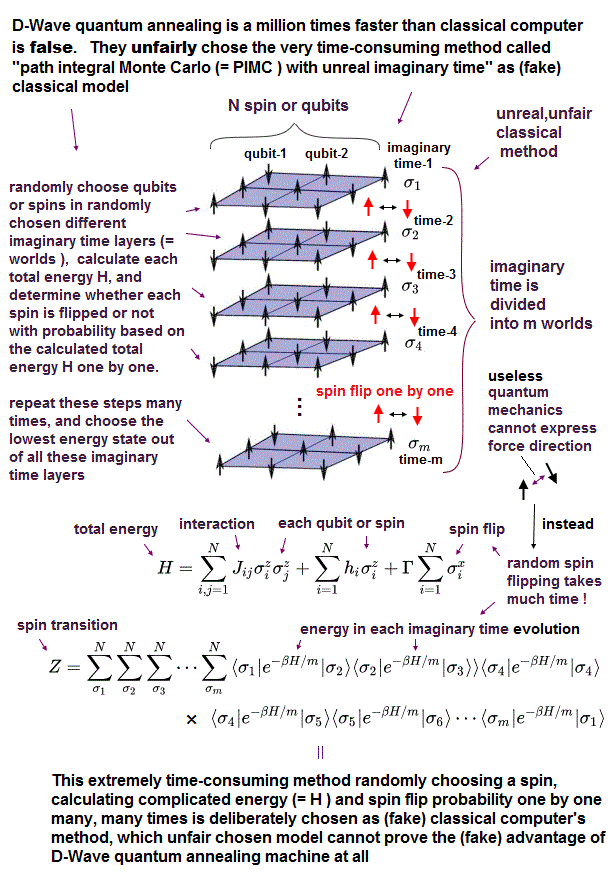
The (fake) quantum advantage of quantum annealing or D-Wave is caused by comparison with the artificially-chosen bad slow classical computer's methods such as simulated annealing and Monte-Carlo.
One of those bad classical methods is path integral Monte Calro (= PIMC ) method or quantum Monte Carlo (= QMC, this Fig.1B ) using the unreal imaginary time, which means PIMC can Not represent the realistic classical calculation method at all.
In this unrealistic very time-consuming classical method called path integral Monte Carlo, they first divide the process of annealing into many fictitious imaginary time periods (= σ1, σ2, σ2 .. σm, this p.2 ).
And then, they randomly chose an arbitrary qubit representing "spin direction" included in random imaginary times one by one, calculated the total energy (=H ) before and after the qubit (or spin ) flip ( 0 ↔ 1, this p.2 ), and decided whether this chosen qubit is flipped or not based on the calculated imaginary-time probabilities (= function of total energy, this p.30-40 ), until the system may reach the lowest energy state ( this p.20, this p.8, this p.9, this p.9 ).
↑ This impractical Monte Carlo classical method takes extremely much time, because it must randomly calculate each qubit's energy or flipping probability one by one without knowing the real forces by which all qubits naturally decide whether they flip or not simultaneously to lower the total energy.
Whether quantum or classical, all things and particles in the nature are gradually evolving into the lowest energy state by interacting and exerting real forces on each other simultaneously, which real classical process in the nature is completely different from these impractical extremely time-consuming artificial classical methods such as path integral Monte Carlo and simulated annealing unfairly chosen for comparison with the quantum annealing.
(Fig.4) Setting the right prime numbers (= 5 and 3 ) as the lowest-energy qubit state for factoring 15 = 5 × 3 using (impractical) quantum annealing.
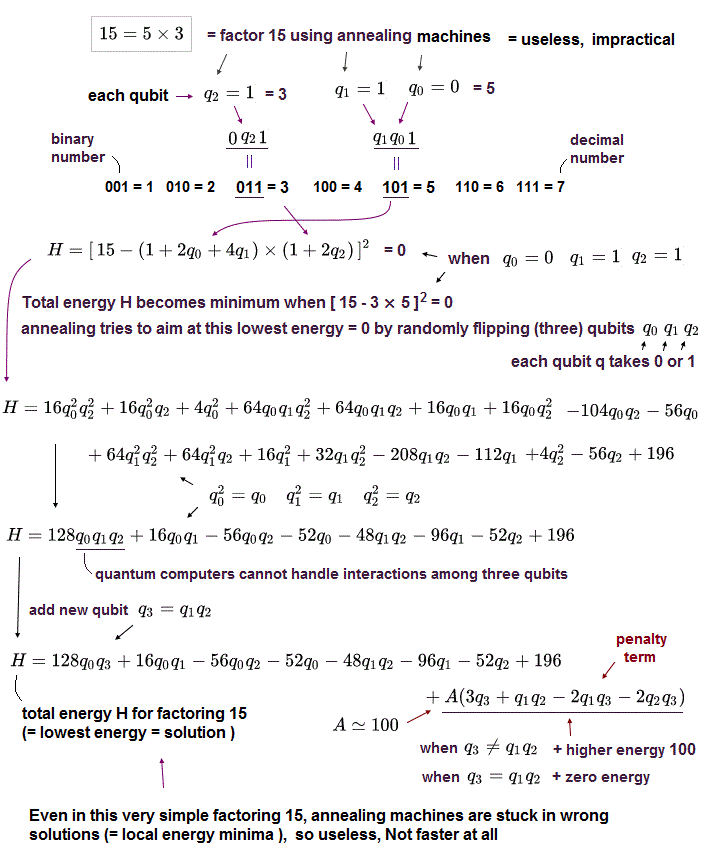
The only way for faster quantum computer's factoring is Shor's algorithm that is impractical (= only fake slower Shor's algorithm for 21 = 3 × 7 can be done ) forever.
Quantum annealing or adiabatic machines treating factoring as optimization problems (= minimization ) are useless, just publicity stunt.
Classical computers are far, far superior.
They encode solutions of factorization into the lowest energy state (= expressed as binary qubit states ) in D-Wave annealing machines.
The problem is quantum annealing or D-Wave often give wrong answers stuck in one of local energy minima instead of the lowest energy state (= right answers, this p.3 ).
Even in factoring the simplest 15 = 3 × 5, D-Wave annealing machines are known to often give wrong answers ( this p.55, this p.7-Figure 1, this p.34 ).
So when this quantum annealing or adiabatic methods try to factor large numbers, they have to know answers in advance to artificially reduce numbers of qubits.
This-p.1-right-lower says -- Fake quantum computer factoring
"the integer N = 291311 had been factorized using
the adiabatic (= equal to annealing, this-lower, this-4th-paragraph ) approach,..
Only 3 qubits were used in this case"
"we have experimentally factorized the integers 4088459 and 966887, using 2 and 4 qubits respectively."
↑ One qubit can take only 0 or 1 value, so just 4 qubits can express only up to 16 (= 24 ), which cannot express such large numbers as 291311, 966887.
↑ So they have to already know answers in advance to reduce numbers of qubits, which quantum adiabatic or annealing's factoring is completely useless.
In this-p.2-(1), they tried to factor 291311 = 523 × 557
↑ A binary number of 523 is "1000001011"
In this-p.2-(1)(2), they just used 3 unknown variables or qubits (= p5, p2, p1 ) to express this 523 = 1000001011 = 1000(p5)01(p2)(p1)1 (= other binary numbers except for these 3 variables must be known in advance ).
↑ So they had to already know the answer 291311 = 523 × 557 to reduce qubits' numbers, which is useless, cannot factor unknown values.
A lot of overhyped fake news says quantum annealing or D-Wave could predict protein-ligand interactions, which is wrong, because quantum annealing (= Not real quantum computers ), which just settle down to some equilibrium states from input parameters, cannot calculate anything such as molecular energy.
Quantum annealing is impractical, needing infinite qubits encoding almost infinite numbers of different interaction energies (= obtained from experiments Not from useless quantum mechanics ) between a molecule or peptides (= in infinite slightly- different positions ) and a protein.
This-overhyped research on D-Wave peptide design (2025) ↓
p.2-right-2nd-paragraph says -- Unreal beads
"We represent amino acids with single
beads and group them into D different chemical families." ← Each amino acid expressed as a bead is Not a real protein.
"Furthermore, we discretize the peptide’s conformational space by introducing a square lattice that fills the pocket P of the target protein.. The lattice spacing is set to match the length of the peptide bond (0.38 nm)," ← This quantum annealing wrong model cannot consider each amino acid's rotation freedom (= including side chains ) which different rotaion angles of different amino acids cause infinite different combinations of amino acids' different positions which need infinite unfeasible constraints.
p.2-right-3rd-paragraph says -- No quantum mechanical prediction
"To derive an expression for the interaction energy, we resort to the Miyazawa-Jernigan knowledge-based potential (= empirical protein amino-acid potential energy with No quantum mechanical prediction )"
p.3-right-1st-paragraph says -- create artificial energy
", we encode condition (4) as a Quadratic Unconstrained Binary Optimization (QUBO) problem. This requires mapping favorable peptide sequences and binding poses onto the low-energy states of a suitably defined quantum Hamiltonian H (= total energy )"
p.3-right-2nd-paragraph says -- Fixed positions
"We introduce a collection of binary variables qki ∈
{0, 1} at each grid point i, which are set to 1 if the site i is
occupied by a residue of type k" ← this method cannot adjust the position of each amino acid of different types k, instead, they fix a amino acide at the center of site i.
p.3-right-(13) says -- Classical computers calculate energy
"E(k)i
is the
(pre-computed) energy an isolated amino acid of type k
would experience at lattice site i due to the interaction
with the target protein’s amino acids in the pocket" ← So instead of the useless quantum annealing, the ordinary classical computer must pre-compute interaction energy between amino acids and target proteins in various sites.
p.6-right-3rd-paragraph says -- Ad-hoc energy model
"In general, the quality of these predictions depends on
three main factors: (i) the accuracy of our coarse-grained
energy model, (ii) the efficiency of the quantum optimization algorithm in identifying high-affinity sequences for
the given pocket, and (iii) the reliability of the docking
software in predicting the correct off-lattice binding pose." ← this result relies heavily on artificial energy model with empirical parameters and classical computer's software with No quantum mechanical prediction.
p.8-right-2nd-paragraph says -- Hybrid = classical computers
"using D-Wave’s hybrid classical/quantum
solver" ← D-Wave hybrid computer is just a classical computer that cannot outperform other good classical computing methods ( this-p.3, this-p.1-abstract ).
↑ As a result, this fake quantum computer's design of peptides binding to proteins heavily relies on ordinary classical computers as deceptive hybrid methods and experimental protein structures with No quantum computation nor quantum mechanical prediction.
This or this-p.17-2nd-paragraph says -- Useless D-Wave
"Despite its pioneering nature, the method (= quantum annealing ) relies on drastic problem simplifications (= needing to know right answer in advance ) and mappings that scale exponentially with chain length... pure quantum annealing still struggles as problem size increases."
This or this overhyped fake news on D-Wave drug design ↓
1st-paragraph says -- Overhyped news
"Polaris Quantum Biotech (PolarisQB) developed QuADD, the first drug discovery software platform built around quantum computing for lead identification. Utilizing a D-Wave Advantage system with over 5000 qubits, QuADD reduces drug design time from years to just hours" ← fake news
↑ This PolarisQB has repeated the same lie that D-Wave quantum annealing might be faster to find molecules bound to some proteins than traditional methods since 2023 ( this or this-p.3-2nd-paragraph ).
This-p.2-left-5th-paragraph (2026) says -- No quantum advantage
"we also evaluate the performance of a
D-Wave quantum annealer on the instances.. and find that, in this setting, adiabatic quantum
computing does Not yield a runtime advantage. Instead,
these instances prove particularly challenging for the annealer"
This or this-Polaris-D-Wave recent paper ↓
p.1-abstract says -- Overhyped fake news
"Quantum-Aided Drug Design (QuADD) is a platform that utilizes quantum computing to solve
a multi-objective optimization problem, producing novel druglike molecules optimized for
interactions within a binding pocket."
p.4-2nd-paragraph says -- Using experimental data
"We selected the thrombin protein and its published structural data as our test system to
evaluate QuADD's performance relative to the AI-based structure-generation method used by
BInD. The inhibitor we used as a reference template is part of the same series of molecules
published in the PDB"
p.4-3rd-paragraph says -- Classical computer used
"The application, MOE (= classical computer software ), was used throughout to both prepare and analyze
molecular structures. An SVL script performed the geometry
optimizations of binding complexes using .. force field"
p.5-last-paragraph says -- Unneeded quantum computer
"The QUBO containing connectible fragments that also exhibit good complementarity to the
binding site is mapped onto the quantum computing architecture" ← So molecular fragments complementary to the target binding site were already found before the unnecessary quantum computers were used
↑ This research used the experimentally-determined thrombin-inhibitor (= binding to the target thrombin ) as a template to find molecules binding to the target thrombin using classical computer software of MOE, SVL script and empirical (= experimentally-obtained ) force field potentials.
So in this research relying on classical computers and experimental data, the quantum computers or D-Wave quantum annealing, which cannot calculate anything such as binding energy, had nothing to do with the prediction of molecules bound to the target thrombin.
This or this-lower Challenges say -- Impractical quantum annealing
"One major challenge of quantum annealing is that it only works well with problems that can be expressed as quadratic unconstrained binary optimization (QUBO) models. Translating real-world tasks—especially those with multiple constraints—into this format is not always straightforward. The process can lead to approximations that compromise the accuracy or usefulness of the solution"
↑ So they had to artificially change the optimization problem into the unphysical QUBO format (= expressed by bits 0 or 1 ) applicable to quantum annealing, and this QUBO already contained molecular fragments complementary to the target binding site before (useless) D-Wave quantum annealing was used.
↑ D-Wave quantum annealing that cannot calculate anything just settles down to the lowest energy (= solution of molecules ) based on parameters artificially chosen in advance ( this-p.3-right-(13), p.4-left-last ), which is irrelevant to quantum computer's prediction of drug molecules.
Furthermore, the quantum annealing machines like D-Wave is impractical due to errors, so their quantum annealer is just a classical computer disguised as a "hybrid computer (= this or this-2nd-paragraph )"
This or this-p.1,p.3 say -- No quantum computer advantage
D-Wave quantum annealing machines showed No quantum advantage, and its hybrid computers are just classical computers."
↑ The alleged drug design or studying proteins by quantum annealing was conducted by classical computers disguised as hybrid computers (= this-p.2-D-Wave hybrid ) based on experimentally-obtained empirical data (= this-p.2-experimental training data ) with No quantum computation nor quantum mechanical prediction.
This-p.2-left-2nd-paragraph used D-Wave hybrid (= classical computer ), and p.2--right-last-paragraph used empirical Miyazawa−Jernigan knowledge-based potential obtained by experiments, Not by useless quantum mechanics
Companies of quantum annealing (= Not real quantum computers ) such as D-Wave have repeated fake quantum advantage with Mastercard (2023), NTT (2024), agricultural, Ford (2025) without disclosing detailed results.
Actually D-Wave founded in 1999 just increases net loss with No real profit from its impractical quantum annealing machines for optimization problems with No hope.
There is still No quantum computer advantage in quantum annealing contrary to D-Wave's fake practical advantage claims ↓
This or this research on useless quantum annealing (2026) ↓
p.6-1st-paragraph says -- No quantum advantage
"Quantum annealing..
Large enough problems to
attain an actual advantage over classical in this setting have not yet been demonstrated, and there have
been multiple more recent preprints demonstrating competitive classical algorithms"
p.6-3rd-paragraph says -- Impractical quantum annealing
"Adiabatic quantum computing is quantum annealing performed within the adiabatic regime.... unlikely to be relevant for real problems"
This-p.1-abstract (2026) says -- No quantum annealing advantage
"The results do not indicate
quantum advantage (in D-Wave hybrid and quantum annealing )"
Recently, D-Wave started to focus on (just) 2 new qubit called dual-rail qubits (= useless forever ) irrelevant to its quantum annealing just to publish papers in top journals, because its quantum annealing for optimization problems are already deadend and hopeless for quantum advantage or even for publishing papers in top journals.
This or this recent D-Wave's overhyped fake news on this new qubit ↓
1st-paragraph says -- Just 2 useless qubits
"the research demonstrates a fast, high-fidelity, two-qubit (= just 2 qubits, Not a quantum computer ) entangling gate that preserves the error-correction advantages (= fake news ) of D-Wave's superconducting dual-rail qubit architecture"
5th-paragraph says -- Illusory practical use
"We believe these results provide strong evidence that the core architectural principles underpinning our gate-model development roadmap can deliver the speed, fidelity and error-correction efficiency required for practical, fault-tolerant quantum computing."
In this new dual-rail qubit consisting of two small cavities, when a photon (= weak light ) is in a cavity-1 (= weak light ), it means a quantum bit or qubit-0, and when a photon is in a cavity-2, it means a qubit-1.
↑ This overhyped D-Wave research used only 2 qubits (= one qubit takes only 0 or 1 value, still Not a computer ) with a lot of errors without error correction, which is far from a practical fault-tolerant quantum computer, contrary to the fake news.
p.2- Fig.1 shows just 2 qubits (= 01 ) far from a quantum computer that needs millions of qubits.
p.3(or p.4)-Fig.2c shows -- Discard ( Not correct ) errors
Just after conducting 100 × CZ gate (= 2-qubit ) operations, about 50% of all results must be discarded (or post-selected = post-selection fraction = 0.5 ) due to errors that cannot be corrected. ← still the final error rate was 10% (= fidelity was 0.9 ).
This-p.3-2nd-paragraph says -- No quantum error correction
"which means that detected errors cannot be uniquely identified and
corrected. We must therefore rely on post-selection to find and discard cases where an error
occurred"
↑ This or this-D--Wave paper review's p.1-2nd-last-paragraph says
"It makes us to wonder if
the readout fidelity is too low to support repetitive measurements, since we believe that the least 10%-40% discard rate per
measurement is not scalable.
"
↑ So this D-Wave's latest research made just 2 impractical dual-rail qubits with high error rates with No ability to correct those errors (= they just discarded erroneous results without correcting errors ), which can never be scaled up to a practical quantum computer.

Feel free to link to this site.