Today's physics needs unreal virtual photons
Today's mainstream quantum mechanics and Einstein relativity without the light medium needs unreal virtual photons with imaginary mass to explain photoelectric effect and Coulomb force.
(Fig.1) An electron emits only an unreal virtual photon with imaginary mass to conserve energy and momentum without the medium
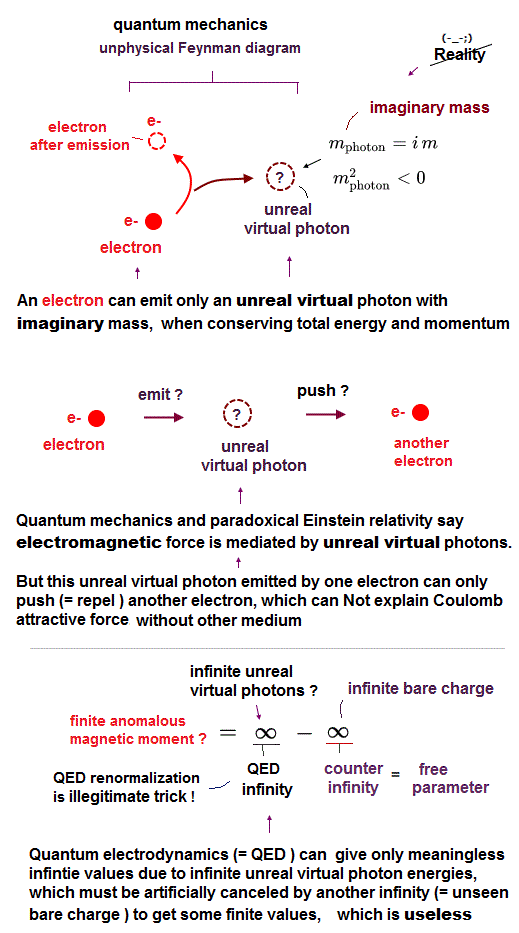
Einstein relativity without the medium needs virtual photons.
Quantum mechanics and quantum electrodynamics (= QED ) are useless, unreal, using illusory virtual photons with imaginary mass as mediators of electric force.
The current quantum theory uses unreal virtual particles as force mediator in particle physics.


Without the real light medium, an electron can emit or absorb only this unreal virtual photon with non-existent "imaginary mass (m2 < 0)" to conserve energy and momentum, disobeying Einstein mc2, which cannot be observed as real particle ( this-p.6, this-p.6 ).


Forces such as electromagnetic are real, but they are caused by unreal virtual particles ? This is why the current physics or quantum electrodynamics (= QED ) is wrong, and must be replaced by real one.
If we admit the real (light) medium in space, we can naturally explain photoelectric effect, nuclear strong force, Coulomb electric force conserving energy and momentum even without the unreal quantum mechanical virtual photons.
An electron emits only an unreal virtual photon
In today's unrealistic relativistic quantum mechanics without the medium, an electron can emit only an unreal virtual photon with imaginary mass ( m2 < 0 imaginary photon mass m ! )
(Fig.2) A moving electron emits a (virtual) photon and stops, conserving total momentum (= p ) and energy (= E ).
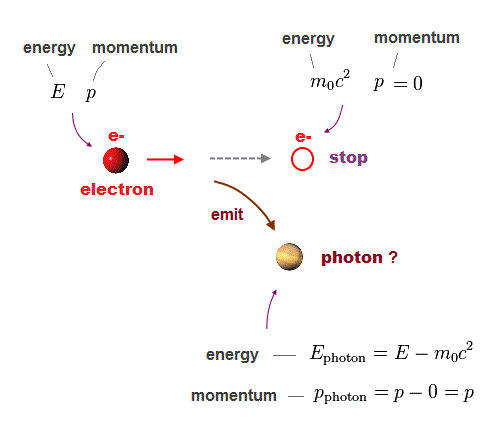
Proof that an electron can emit only an unreal virtual photon with imaginary mass ( m2 < 0 )
When an electron emits a photon (= light particle ? ) in today's paradoxical mainstream physics without the light medium, this photon always must be virtual (= Not real ) with imaginary mass ( m2 < 0 ) when total energy and momentum is conserved ( this-p.3, this-p.6 ) !

In all reactions, total energy (= E ) and momentum (= p ) must be conserved.
The initial energy and momentum of an electron are E and p, respectively. This electron stops after emitting a photon.
According to Einstein mass relation, the energy of the stationary electron is rest mass energy (= m0c2 ), and its momentum is zero.
Due to conservation law, the energy and momentum of the emitted photon is E - m0c2, and p, respectively.
Einstein's energy and momentum relation.
Particle's energy (= E ), momentum (= p), rest mass (= m0 )
(Fig.3) ↓ Einstein relativistic relation.
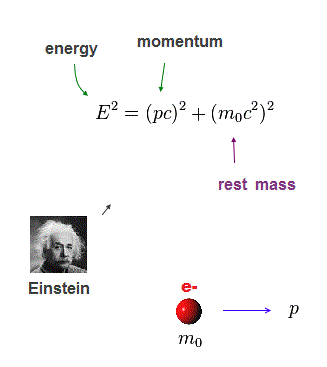
According to Einstein relativity, all ( real ) particles have to obey his energy-momentum-mass relation.
E, p and m0 are each particle's energy, momentum and rest mass, respectively.
Emitted photon's mass squared is negative !
Photon emitted from a electron has "imaginary" mass ( m2 < 0 ) !
(Fig.4) Photon with negative mass squared is virtual, NOT real.
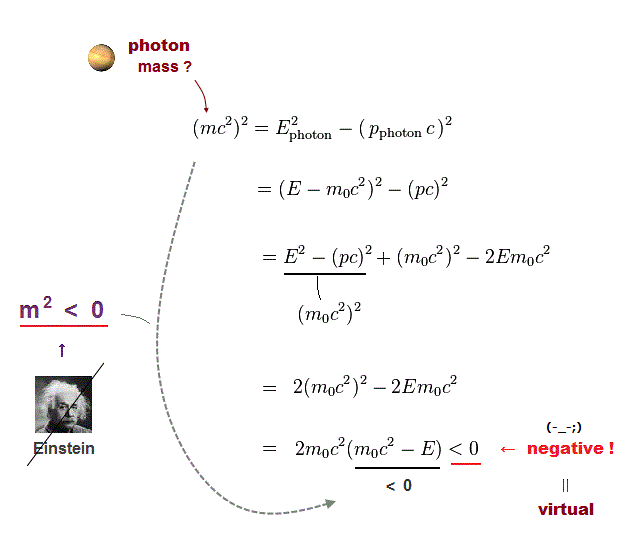
An electron emits only an unreal virtual photon with imaginary mass ( photon's mass m2 < 0 ) ← A photon doesn't exist.
Inserting the energy E and momentum p of the emitted photon into Einstein's relation, you'll easily find this emitted photon has unreal mass whose mass squared is negative (= a virtual photon's m2 < 0 ), which means this virtual photon has an unreal imaginary mass ( this-p.18 ).
In Fig.4, rest mass energy (= m0c2 ) is always smaller than total energy (= E = the sum of rest mass and kinetic energies ), so the final result is negative ( m2 < 0 ← the emitted photon's mass squared becomes unrealistically negative ! )
So when a photon emitted from an electron conserves total energy and momentum, its mass squared becomes negative (= imaginary mass ) and unreal.
In Einstein relativistic theory, all observers see this same imaginary mass of a virtual photon (= because this Einstein-mass energy equation is invariant irrelevant to observers' motion ), though the imaginary mass itself is unobservable.
It means a photon model in relativistic quantum field theory (= without the real light medium ) fails due to these contradictory virtual photons with unreal masses, and we have to consider other realistic wave model involving the "whole atom" and medium to avoid this unreal virtual photon's imaginary mass.
Fractional-charge quark lacks reality.
Nuclei consists only of real protons and neutrons (= electrons + protons ), so unseen fractional-charge quarks and gluons are unnecessary.
(Fig.5) ↓ A neutron consists of a proton and an electron, Not quarks !
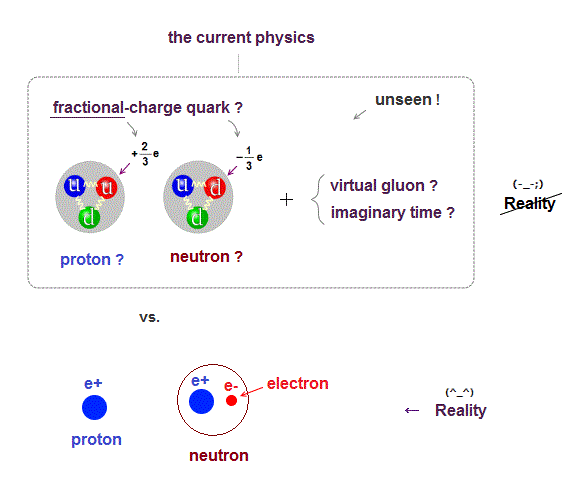
We don't need unreal unobservable quarks.
Only protons and neutrons (= each neutron consists of a proton and an electron ) are real.
The current physics says a proton and a neutron consist of fractional-charge quarks, which can Not be separated or detected.

They insist a nucleus is filled with unreal virtual sea quark-gluon, and governed by imaginary time ( this-p.3 ) and extradimension.
The fact of neutron decay tells us each neutron simply consists of a proton and an electron, Not unseen quarks.
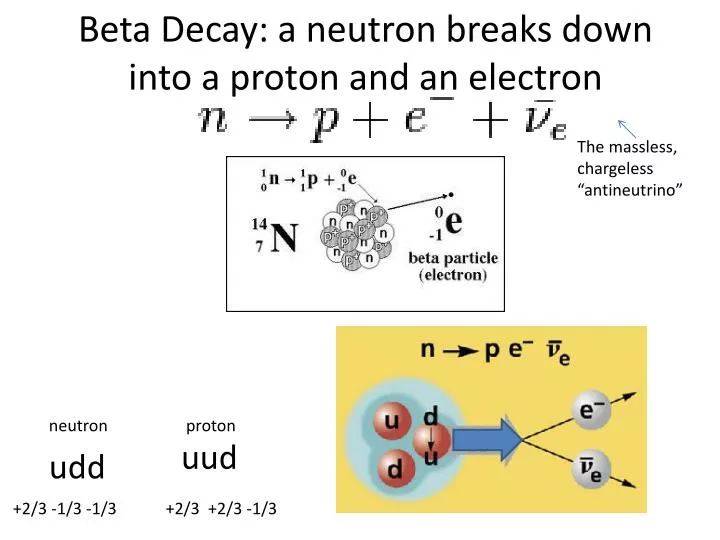
The current nuclear physics lacks reality, full of imaginary concepts and artificial adjustable parameters ( this p.5 ), so useless and prevents nuclear fusion research.
A neutron decays into a proton and an electron.
Today's unreal particle physics says a neutron decays into a much heavier ( unreal ) virtual Weak boson (= 80 times heavier than a proton and a neutron !? ) violating energy conervation law.
(Fig.6) ↓ The current physics uses unreal virtual W boson.
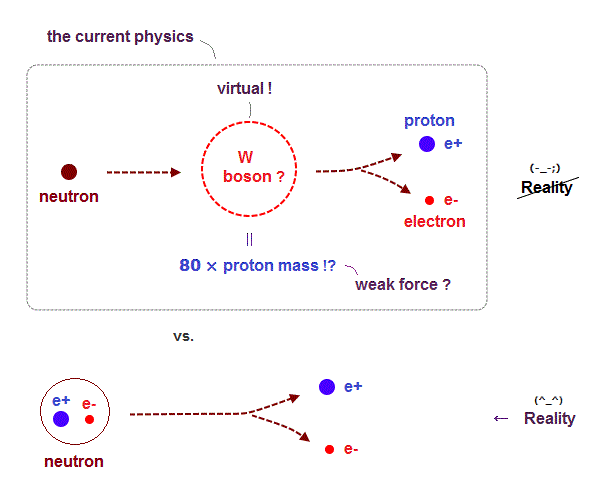
A neutron consists of a proton and an electron.
We do Not need unreal unseen fractional-charge quarks and virtual W bosons violating energy conservation law.
A neutron decays into a proton and electron in beta decay.
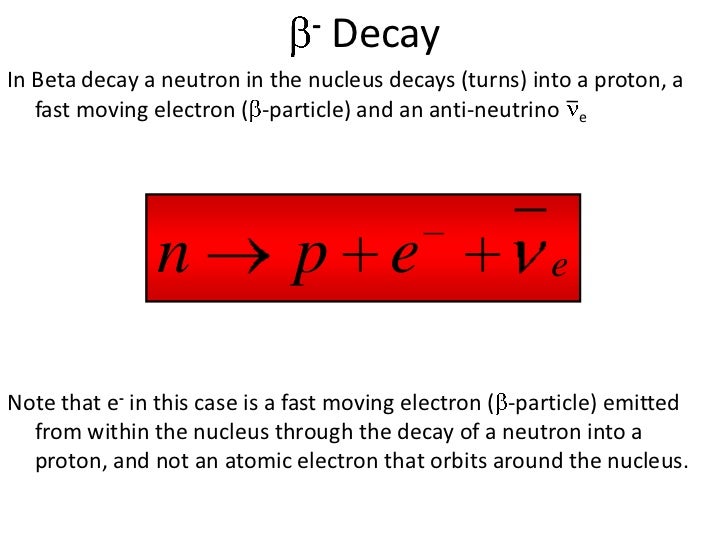
The current unphysical physics insists imaginary quarks inside neutron decays into virtual Weak boson, which is 80 times heavier than a proton ( or a neutron ) ! ← lacking reality and experimental evidence.
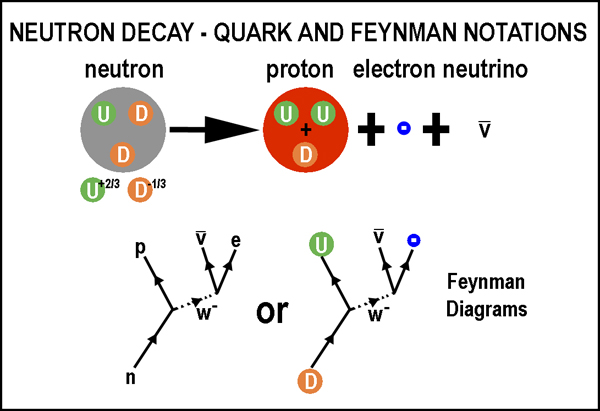
It is impossible that a neutron emits weak boson, which is much heavier than a neutron itself, so they call it unreal virtual particle.
We don't need these contradictory, unreal, useless particles or artificial models.
We can simply say a neutron decays into a proton and an electron !
Nuclear binding force is short-distance Coulomb.
Neutron ( = proton + electron ) is necessary for forming nuclei, which shows nuclear strong force is short-distance Coulomb force between electrons ( inside neutrons ) and protons.
(Fig.7) ↓ The current nuclear model is full of unreal concepts.
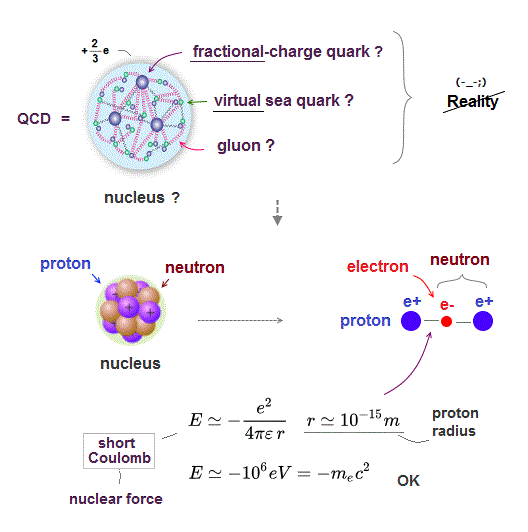
Quarks are unreal, unobservable.
Today's particle physics baselessly says a nucleus consists of (unreal) virtual quarks with unobservable fractional charge.
The current nuclear model is full of imaginary concepts, such as unseen fractional-charge quark, virtual sea quark-gluon ..
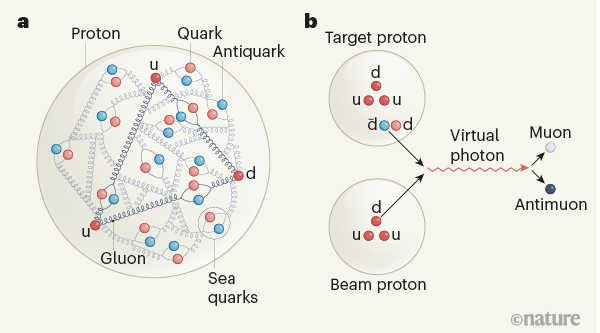
But these virtual quarks or fractional charges can never be observed, so we do Not need them.
Electrons inside neutrons bind protons in nuclei.
Nuclei always need neutrons consisting of electrons and protons, which shows nuclear binding force is short-distance Coulomb force between electrons inside neutrons and protons.
Nuclei always consist of protons and neutrons.
There are No helium-2 whose nucleus consists only of two protons nor lithium-3 whose nucleus consists only of three protons.
As protons increase inside nuclei, neutrons increase, too. A neutron consisting of a proton and an electron is always necessary to form nuclei.
The current physics completely ignores these electrons inside nuclei, and focuses only on imaginary virtual particles.
Electrons very close to protons inside small nuclei can exert strong attractive force among protons inside nuclei.
↑ This strong short-distance Coulomb force between electrons inside neutrons and protons is the real nuclear strong force.
Short-distance Coulomb force between electrons inside neutrons and protons are strong enough to cause strong nuclear binding force.
From the proton radius (= 10-15 m ), we can estimate Coulomb energy between an electron and a proton inside nuclei, which is very big.
This short-distance Coulomb energy becomes about 1 MeV (= 106 eV ), which is almost as big as the electron's mass energy (= mc2 )
So, we can say strong nuclear force is caused by Coulomb force between a proton and a electron inside neutron, instead of imaginary quark- gluon with unobservable fractional change that is unnecessary.
We need to explain nuclear binding force by using only real electrons (= inside neutrons ) and protons that are experimentally observable in contrast to the imaginary unobservable fractional-charge quarks.
Short-distance Coulomb force binds nuclei.
Electrons inside neutrons are necessary to bind protons inside nuclei, which is why there is No Helium-2 nor Lithium-3 whose nuclei consist only of protons.
(Fig.8) ↓ Helium-2 whose nucleus consists only of two protons without electrons does Not exist, which shows nuclear binding force is short-distance Coulomb force between electros inside neutrons and protons.
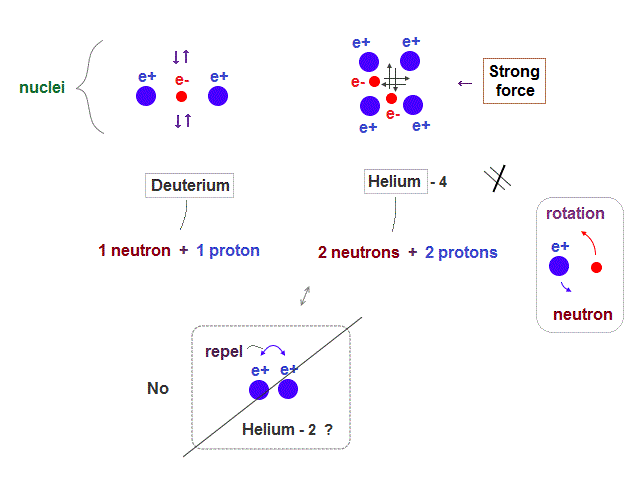
All nuclei need neutrons including electrons to bind protons.
There is No helium-2 nor lithium-3 consisting only of positive protons, because nuclear binding force is short-distance Coulomb force between electrons inside neutrons and protons.
In Helium isotope, there are only Helium-3 and Helium-4. ← Both of these He-3 and He-4 nuclei contain electrons as a form of neutrons (= each neutron consists of a proton and an electron ).
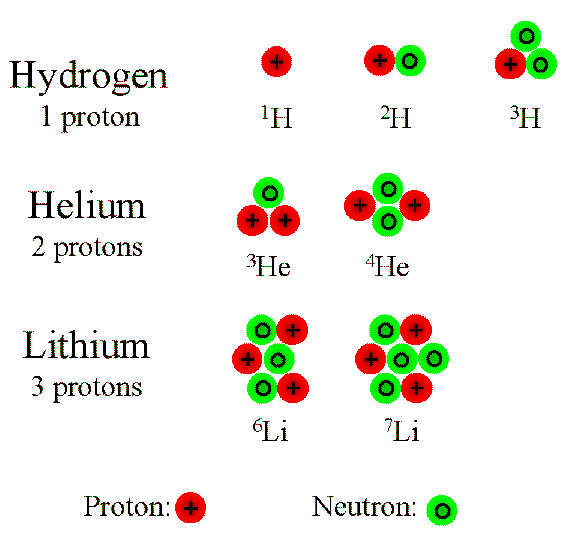
Helium-2 or Lithium-3' nuclei consisting only of two or three protons without neutrons or electrons cannot exist.
Nuclear binding force is short-distance Coulomb force between electrons inside neutrons and protons.
This fact proves that electrons inside nuclei act as "adhesive" among protons inside nuclei.
The fact that electrons are also major components of nuclei can be confirmed from observing nuclei absorbing electrons (= electron capture ) or nuclei emitting electrons (= beta minus decay ).
A neutron consists of an electron and a proton.
An isolated neutron tends to be a hydrogen atom, because an electron starts to rotate (= instead of oscillate between protons inside nuclei ) in the orbit whose length is an integer times de Broglie wavelength to avoid destructive interference.
Nuclei include more protons than electrons, so electrons are oscillating (= an integer times de Broglie wavelength in a circular orbit is irrelevant ) among protons, instead of rotating around protons.
When there is only a pair of an electron and a proton like in neutron, the electron tends to rotate around the proton, which become a hydrogen where the electron's orbital is stable, when its length is an integer times de Broglie wavelength (= avoiding destructive interference of de Broglie wavelength ).
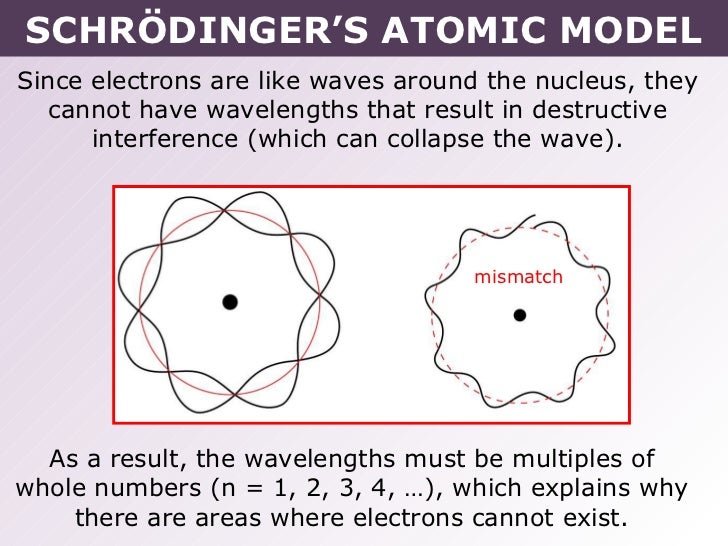
Virtual quarks' (fictitious) strong force cannot explain why Helium-2 (= diproton ) cannot exist.
Short-distance Coulomb force between electrons inside neutrons and protons causes realistic strong nuclear attraction even without unreal virtual quarks, gluons.
(Fig.8') ↓ True Coulomb nuclear force can explain why Helium-2 cannot exist, and Helium-4 is the most stable and abundant.
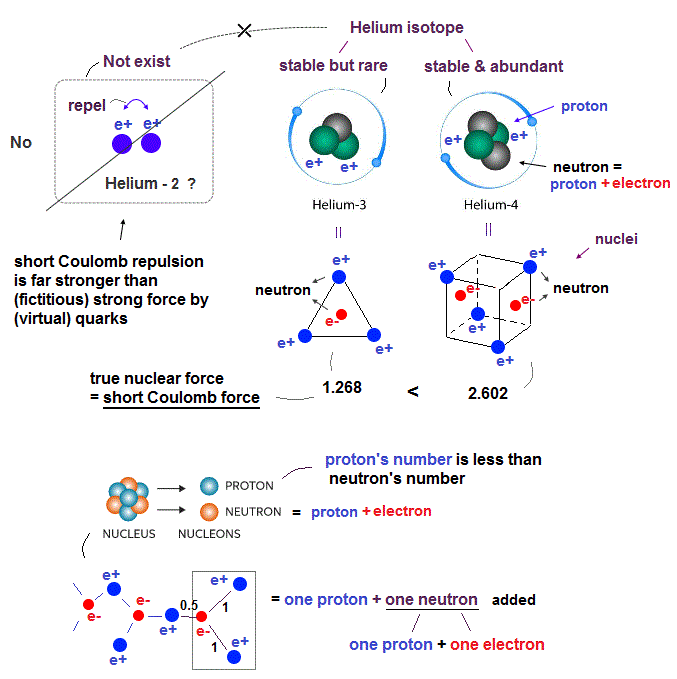
Helium-2 without neutrons or electrons doesn't exist.
The illusory strong force by unseen quarks, gluons is weaker than Coulomb force ? this is why Helium-2 does Not exist ? ← Only realistic Coulomb force is necessary for nuclear strong force.
If the current mainstream (fictional) particle physics is true, Helium-2 whose nucleus is composed only of two protons or diproton, must exist stably.

But this Helium-2 cannot exist, because Helium-2's nucleus consists only of two positive protons, and strong Coulomb repulsion between these two protons prevents Helium-2 formation.
↑ This means the (fictitious) strong force through imaginary unseen fractional-charge quarks and (virtual) gluons is weaker than short-distance Coulomb force, even if such a strong force via (fictional) quarks existed.
So the fictitious quantum mechanical strong force allegedly via virtual quarks and gluons is meaningless (= less influential, even if it existed ), and only realistic Coulomb force between electrons (= neutrons ) and protons can exert strong decisive repulsion and attraction also inside nuclei.
The more protons, the more neutrons or electrons.
More neutrons including electrons are needed in larger nuclei, which shows nuclear binding force is short-distance Coulomb force between electrons inside neutrons and protons.
It is known that atomic nuclei consist of protons and neutrons where the number of protons is equal to or less than the number of neutrons.
A neutral neutron consists of one positive proton and one negative electron, so this negative electron inside a neutron works as adhesive between repulsive positive protons through short-distance Coulomb attraction between positive protons and negative electrons.
This short-distance Coulomb force used as true nuclear force can explain why Helium-2 (and Lithium-3's nucleus with three protons ) cannot exist due to lack of negative electrons (= adhesive ) between two or three protons.
In Helium isotope, Helium-4, whose nucleus consists of two protons and two neutrons (= which are equal to four protons and two electrons, because each neutron consists of one proton and one electron ), is known to be the most stable and abundant.
Helium-3, whose nucleus consists of two protons and one neutron (= which are equal to three protons and one electron ), is also stable but far less abundant than Helium-4, because its short-distance Coulomb attraction is about two times weaker than the Helium-4's Coulomb attraction (= the above figure numbers such as 1.268 < 2.602 means the ratio of the strengths of short-distance Coulomb nuclear attraction between Helium-3 and Helium-4 ).
Short-distance Coulomb force explains nuclear binding force, and de Broglie wave interference suppresses excessive neutrons.
It is known that each atomic nucleus consists of almost same number of protons and neutrons.
One proton and one neutron ( a neutron = proton + electron ) are equal to two protons and one electron.
As shown in the above figure-lower, we show that it is possible to add one proton + one neutron (= equal to two protons + one electron ) to the rest particles of each nucleus consisting of an arbitrary number of protons and neutrons, obeying Coulomb attraction (= in the upper figure, the distance between a new electron and an already-existing proton is supposed to be a half of the distance between a new electron and new protons ).
As a result, we can also explain why atomic nuclei consist of almost the same numbers of protons and neutrons using the realistic short-distance Coulomb force replacing fictitious meaningless strong force via virtual quarks and gluons.
A neutron tends to become a H atom, because electron's de Broglie wave interference prevents the electron from returning or getting closer to a proton.
As I said, if each nucleus contains the same numbers of protons and electrons (= which means this nucleus consists only of neutrons without protons = excessive neutrons ), each electron cannot stay between two protons (= because the number of electrons increases to the same number of protons ), and some electrons tend to rotate around the positive protons (= remain as a part of nucleus with the remaining less electrons or neutrons ).
↑ Like the ordinary atomic orbits, the electron de Broglie wave interference (= orbital length cannot be shorter than an integer number 1 × de Broglie wavelength to avoid destructive interference of de Broglie wave ) prevents some electrons from returning to the initial very small area between protons inside nuclei, hence, nuclei always become positive Not neutral.
↑ This de Broglie wave (destructive) interference of an electron rotating around the proton can explain why a neutron is unstable, separating an electron from a proton to become a hydrogen atom.
So the realistic short-distance Coulomb force and de Broglie wave nature can perfectly explain why the number of protons is almost equal to (= or slightly less than ) the number of neutrons inside each nucleus.
Light in medium dismisses unreal virtual photons
Instead of an electron emitting (unreal) virtual photons with imaginary mass, de Broglie wave of an electron orbiting around a nucleus interacts with light wave in medium conserving energy and momentum realistically.
(Fig.9) ↓ Electron emits light in the "transverse" direction.
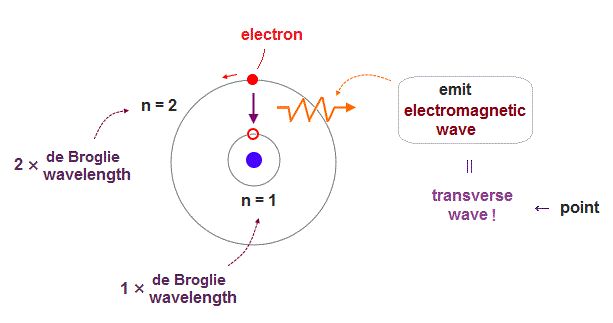
Electron emits Not the unreal quantum mechanical virtual photon but the realistic light wave.
The only way to avoid quantum mechanical unreal virtual photons with imaginary mass is light wave energy interacting with the electron's de Broglie wave oscillating energy in the medium.
According to the present unphysical quantum mechanics and QED, an electron can emit or absorb only an unreal virtual photon with imaginary mass, violating Einstein relativistic energy-mass relation, when the total energy and momentum are conserved ( this-p.10, this-p.15, this-p.3-3rd~4th-paragraphs ).


↑ We can avoid this unreal virtual photon, if we use classical light wave in the medium.
When the excited electron of the higher energy level of n = 2 returns to the lowest-energy ground state of n = 1 energy level, the electron's de Broglie wave energy (= stored in the medium around the electron ) is emitted as light wave whose transverse oscillation stores part of initial electron's de Broglie wave energy.
↑ The total momentum combining the electron and nucleus is almost unchanged (= in the periodic circular motion ), which can emit real light wave (= or a fictional photon ) with large energy and smaller momentum ( this-5-6th-paragraphs ) by conserving the total energy and momentum.
So instead of the unphysical quantum mechanical electron emitting unreal virtual photon ( this-p.3 ), the medium around the electron and the proton generates the real light wave from the electron's de Broglie wave.
To conserve both energy and momentum between a heavier electron and a lighter photon with smaller momentum, the transverse oscillating energy of light is absorbed into or emitted from the electron's de Broglie wave's oscillating energy (= equal to electron's kinetic energy) stored in the medium.
↑ When the electron's de Broglie wave absorbs or emits light wave energy to increase or decrease de Broglie wave's frequency (= electron's kinetic energy ), the electron pushes the medium around it (= which changes the nuclear momentum ) to conserve also the total momentum. ← So the medium is necessary to avoid relying on unreal virtual photons.
Maxwell's electromagnetic wave can perfectly explain photoelectric effect even without unphysical virtual photon particle.
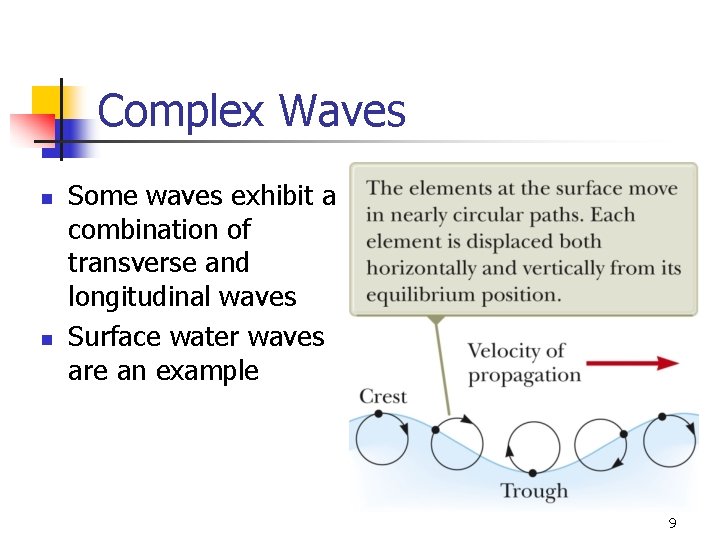
Realistic light wave is a combination of "transverse" and "longitudinal" wave traveling through the medium.
(Fig.10) ↓ Electromagnetic light wave emitted from the orbiting electron is a transverse and longitudinal oscillating wave whose wave phase velocity is the constant light speed c, and the light energy is proportional to frequency f satisfying photoelectric effect.
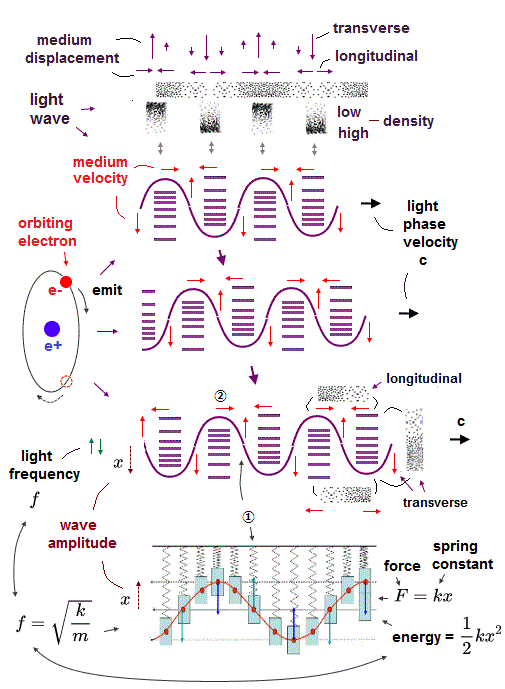
Light is Not a photon particle but wave that can explain photoelectric effect.
Contrary to the ordinary explanation, classical realistic light wave can naturally explain photoelectric effect where an electron can emit or absorb the light wave.
The present quantum mechanics and QED has to rely on unreal virtual photons with imaginary mass interacting with electrons in photoelectric effect.
In photoelectric effect, the light energy proportional to light frequency is absorbed into or emitted from an electron's de Broglie wave's oscillating energy (= frequency = c/wavelength means light is wave, Not a photon particle ) by conserving energy and momentum realistically.
↑ This light energy proportional to frequency can be naturally explained by classical light wave interacting with electron's de Broglie wave whose kinetic energy is related to frequency in the medium.
Light is the complex wave mixing transverse and longitudinal waves.
Light's transverse oscillating energy is absorbed into or emitted from an electron's de Broglie wave's oscillating energy equal to kinetic energy.
Electromagnetic wave can be considered as wave mixing transverse and longitudinal waves. ← The transverse oscillating energy is absorbed into or emitted from electron's de Broglie wave oscillating in the same direction as the light's transverse oscillation with the same frequency, which can explain why photoelectric effect is related to light frequency.
We can compare the light wave oscillation (in the light medium ) with the oscillating spring whose spring constant is k.
Classical light can explain photoelectric effect.
Classical light wave in the medium associated with spring oscillation can explain why photoelectric effect's energy is related to light frequency.
↑ The spring energy is expressed as 1/2kx2 related to both (light's medium's) frequency f (= related to spring constant k ) and the (light medium's) amplitude x.
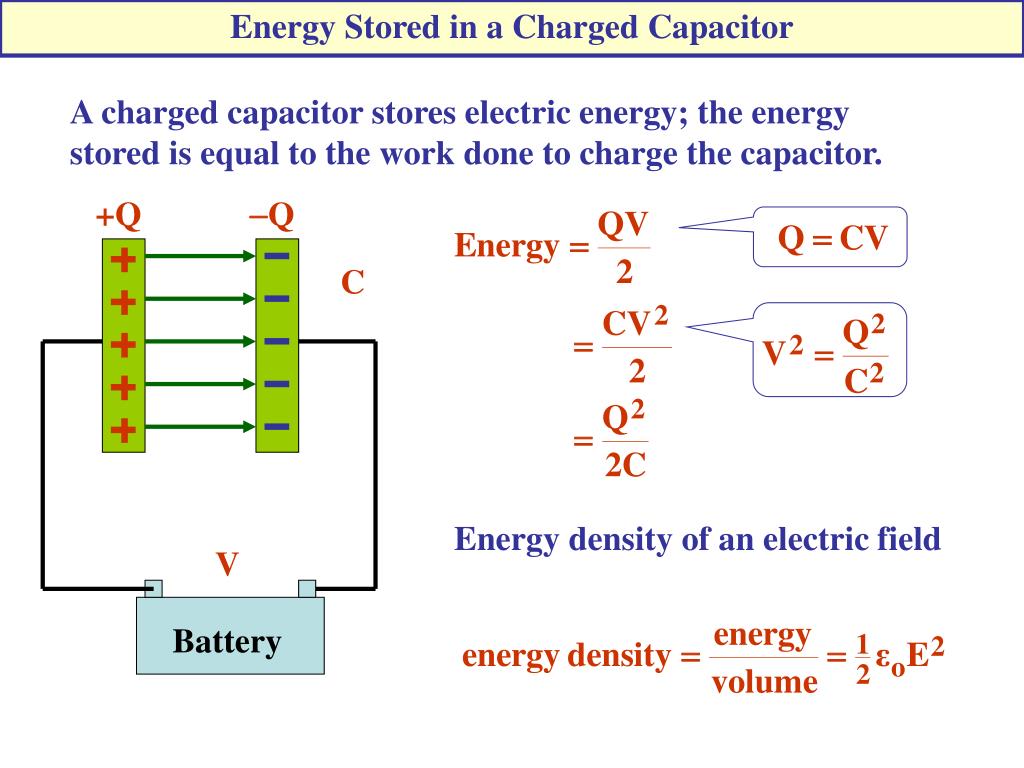
If we assume this spring's energy 1/2kx2 equals the light's energy 1/2εE2 where E is the electric field, ε is the electric constant, we can say the electric field E is proportional to the (light medium's) displacement x × square root of k (= spring constant k is related to how steep the light's medium's density gradient is ).
↑ Electric force is equal to the electric field E (= x × square root of k ) × charge (= space derivative of the electric field E = square root of k ), which is compatible with electric force = kx (= spring force ).
↑ This electric field energy density = 1/2εE2 is generated from Coulomb electric energy among many charges, Not from a single electron's electric field, so light's energy emitted from a single electron tends to be equal to E = hf (= h is Planck constant, f is light frequency ) rather than E = 1/2εE2
The magnetic field can be considered as the spring or the light's medium's kinetic energy (= time derivative of the electric field E equal to magnetic field ) compared with the electric field E related to the light medium's displacement x (and the medium's density gradient k ).
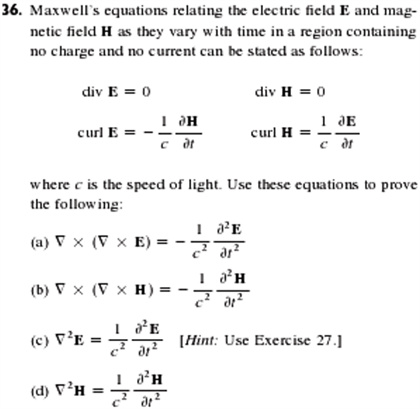
As a result, in the photoelectric effect, the light medium's frequency f needs to surpass some threshold to excite the electron's de Broglie wave, which can be perfectly explained by the realistic classical light wave.
Photoelectric effect by photons is wrong.
Classical light wave (= discrete light packet ) interacting with electron's de Broglie wave can explain why there is almost no time lag in emitting electrons in photoelectric effect.
We often see the (false) explanation that if light is wave. it takes longer time for an electron to absorb energy enough to be ejected from a atom than the case where light is a photon particle in photoelectric effect ( this-4th~5th-paragarphs ).
But actually, electrons in atoms are constantly absorbing various light energies even without the light source ( this-p.2 ).
And electron's de Broglie wave interacting with light spreads over larger area than a single atom, as seen in de Broglie wave interference, which can explain electron's de Broglie wave absorbing light spreading over large area in short time.
Even in the very weak light source, each light is emitted from a single atom (= light is divided into discrete light packets ), so some small light wave packet emitted from an atom inside weak light can instantly eject an electron in another atom in photoelectric effect.
As a result, classical light wave can perfectly explain photoelectric effect even without quantum mechanical unreal (virtual) photons.
Neutrino is "wave" like light.
Neutrino is "longitudinal" wave with light speed c.
(Fig.11) Why "neutrino" and "light" always travel at light-speed c ?
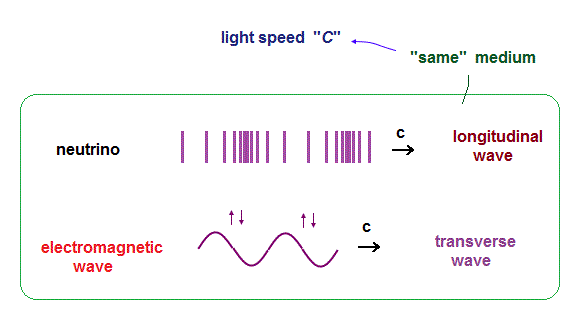
Neutrino is longitudinal wave in the medium, which can explain why the elusive neutrino always travels at light speed c.
It is known both neutrino and electromagnetic wave always travel at light-speed c.
"Constant" speed means these things are some oscillations travelling in the same common medium.
We can naturally think that this neutrino is longitudinal wave (= because the neutrino is basically emitted from nuclear reaction, not from atomic electrons periodically orbiting around nuclei ), and the light is "transverse (= complex )" wave travelling through the common medium with the light speed.
If the neutrino is longitudinal wave, it doesn't interact with electron's orbit in the transverse direction, which can explain why "neutrino wave" can pass through things like ghost.
True mechanism of photoelectric effect.
Electron's de Broglie wave's frequency is related to emitted light's energy based on frequency in real photoelectric effect without unreal quantum mechanical virtual photons.
(Fig.12) light energy = h × frequency f.
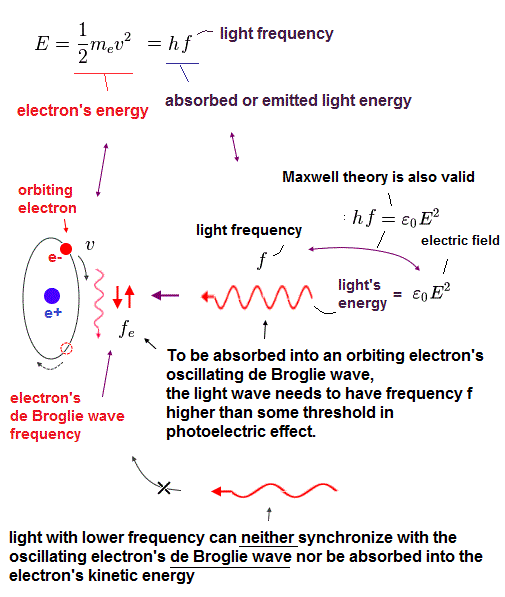
Light wave interacts with electron's de Broglie wave
Light wave's transverse oscillating energy is absorbed into or emitted from the electron's de Broglie wave's oscillating energy stored in the medium to conserve energy and momentum even without unreal quantum mechanical virtual photons with imaginary mass.
The realistic classical light wave can naturally explain the photoelectric effect showing the light emitted from atom has the energy of hf ( h is Planck constant, f is light frequency ).
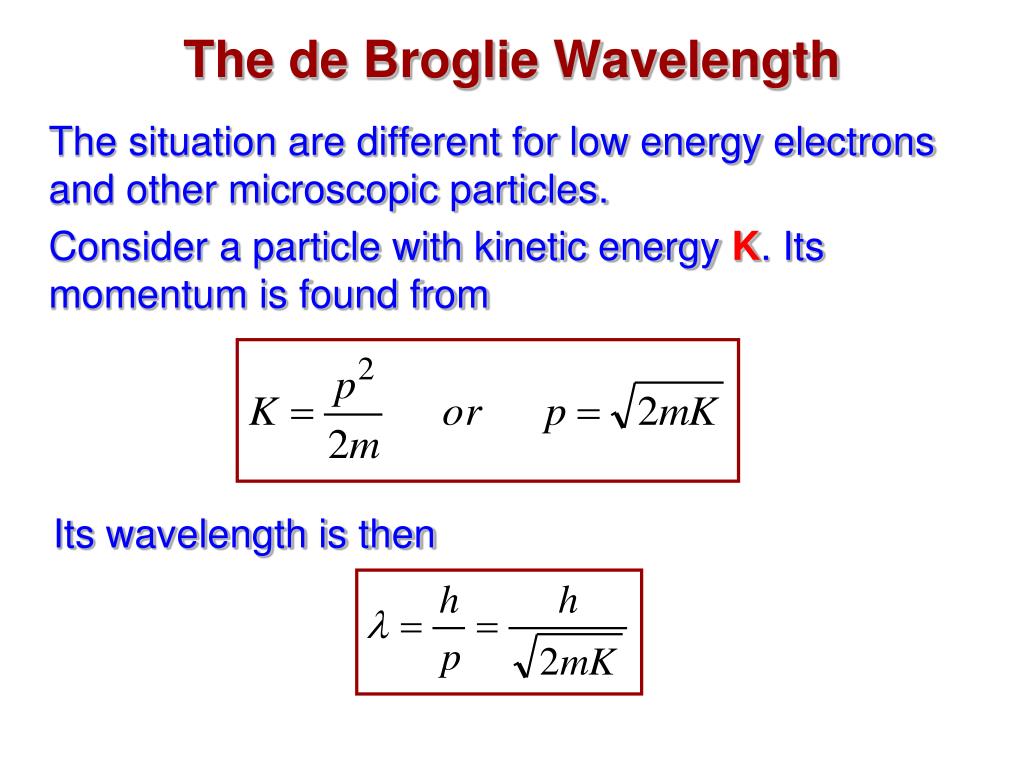
We suppose an electron's de Broglie wave storing the electron's kinetic energy of 1/2mev2 = 1/2p2/me ( me and v are electron's mass and velocity, p is electron's momentum = mev ) emits light to conserve total energy and momentum even without unreal quantum mechanical virtual photons with imaginary mass.
( To be correct, the whole atom of electron and nucleus emits the light or electromagnetic wave by pushing the medium around them, avoiding the contradictory QED virtual photon allegedly emitted from the inside of an electron, the nuclear kinetic energy is so small that it can be neglected ).
Light's energy proportional to frequency is due to electron's de Broglie wave theory in photoelectric effect.
Reason why light's energy is proportional to light frequency is based on electron's de Broglie wavelength inversely proportional to electron's momentum.
(Fig.13) de Broglie wavelength (= λ ) = h/p, p (= mev, me and v is electron's mass and velocity ) is momentum
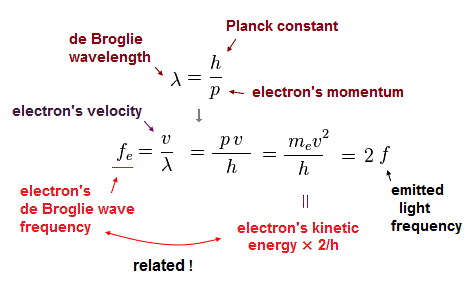
Frequencies of light and electron's de Broglie wave are equal.
Electron de Broglie wave frequency can perfectly explain the emitted light energy frequency in photoelectric effect.
According to wave relation, frequency f is equal to velocity (= v ) divided by wavelength ( λ ).
When an electron is moving at a velocity of v, its de Broglie wavelength becomes λ = h/mv = h/p ( p is electron's momentum = mv, h is Planck constant ).
From Fig.12 and Fig.13, we get the relation of electron's de Broglie wave frequency (= fe ) equal to the electron's kinetic energy × 2/h (= mv2/h ), which is twice the emitted light frequency (= 2f ).
↑ As shown here, the electron's kinetic energy is proportional to its de Broglie wave's frequency (= fe ), which is why the energy of the light interacting with the electron (= de Broglie wave ) must be related to the light frequency in addition to the light intensity in photoelectric effect.
Electron's de Broglie wave is known to spread over large area like light wave as shown in experiments of de Broglie wave's interference and diffraction, which can also perfectly explain why spreading light wave (= actually spreading light is divided into multiple light wave packets ) can interact with electron's de Broglie wave in light's absorption and emission.

Average frequency of "damped" electron's oscillation is equal to emitted light (= f ).
We think about the case in which oscillating electron gradually emits light and loses its kinetic energy.
The initial electron's de Broglie wave's frequency is equivalent to 2 × f (= emitted light frequency ), as shown in Fig.13.
The more light the electron emits, it loses more energy, and its oscillation becomes slower ( to be zero ).
It means the average electron's de Broglie wave frequency becomes half of the original value (= 1/2 × fe = f ) .
As a result, we can prove that the emitted light frequency f is equal to the electron's de Broglie wave energy's average frequency, f = fe.
This is the mechanism of photoelectric effect using "real" light and electron's de Broglie wave in the medium.
Why proton and electron charges are exactly the same amount ? ← Accidental agreement is unnatural.
The current quantum mechanics cannot answer why the universe contains the same amount of ±charges.
(Fig.14) Imbalance in the medium's density causes plus, minus charges.
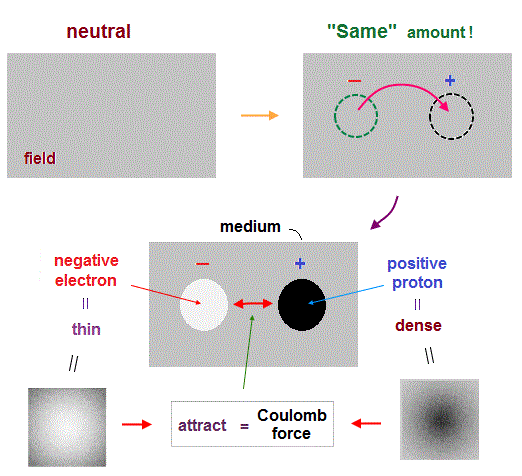
Positive proton and negative electron are higher and lower densities in the medium.
A positive charge with higher density attracts a negative charge with lower density in the medium, which can explain repulsion between two positive charges (= higher density clashes with higher density ), or between two negative charges (= lower density repels lower density ).
Quantum mechanics cannot answer the question "why the universe contains exactly the same amount of plus, minus charges" as protons and electrons. And they have NO definite answer, "why a proton is much heavier than an electron".
If we suppose Coulomb force is caused by the difference in field pressures (= medium's density difference ), we can naturally answer all these basic questions.
In Fig.14 upper, some number of field (= medium ) substances are transferred to another places.
This causes a pair of "thin" area with lower pressure (= lower density = negative electron ), and "dense" area with "higher" pressure (= positive proton ) in the field (= medium ).
If the medium's substances are unevenly distributed, they try to go back to the uniform density, which is the origin of Coulomb attraction. Denser proton (= attracted to lower-density electron ) is naturally heavier than "thin" electron.
Due to pressure balance, the combinations of "dense-dense (= +, + )" and "thin-thin (= -, - )" areas repel each other, which is why the same charges repel each other in Coulomb forces.
A positive proton (= higher density in the medium ) is heavier than a negative electron (= lower density in the medium ).
Total momentum conservation causes an light electron to move much faster.
(Fig.15) An proton is 1840 times heavier (= denser ) than an electron.
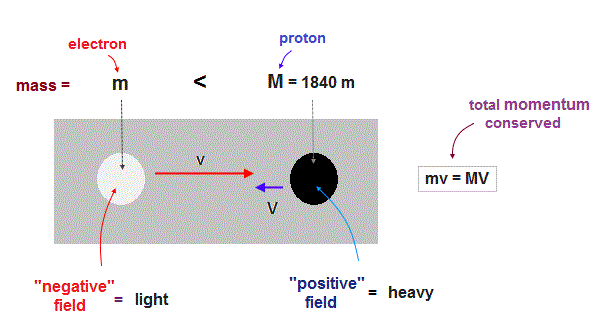
Coulomb electric charge caused by imbalance in the medium's density can explain why a proton is much heavier than an electron.
It is known that a proton is about 1840 times heavier than a electron. If we suppose, a proton (= positive field ) is 1840 times denser in the medium than an electron (= negative field ), this big difference in mass (= charge's mass is related to the medium's density + medium's substance's oscillating energy caused by imbalance in density ) can be explained.
Due to imbalance in the medium densities (= "positive" is dense, "negative" is thin ), the opposite charges attract and start to move towards each other.
Total momentum ( and center of mass ) must be conserved due to the law of action and reaction.
So a "light" electron must move much ( 1840 × ) faster than a heavy proton during the same time.
↑ The negative charge, which is lower density of the medium, also has small mass or momentum, because if the negative charge has No mass nor momentum, the positive charge = higher-density substances cannot approach the lower density area in the medium by conserving total momentum.
↑ When the positive charge is accelerated and attracted toward the negative charge, the higher-density substances in the positive charge have to push the surrounding medium in the opposite direction (= due to action-reaction law ), which pushed surrounding medium pulls the negative charge = lower density substances, causing negative charge's small mass.
Einstein relativity lacking the absolute frame (= medium ) is wrong due to Not conserving energy and momentum
Coulomb electric force caused by difference in the medium's density can explain the rest mass energy defect in particles attracting each other in lower potential energy.
(Fig.15') Einstein relativity denying the medium can Not explain mass defect by potential energy.
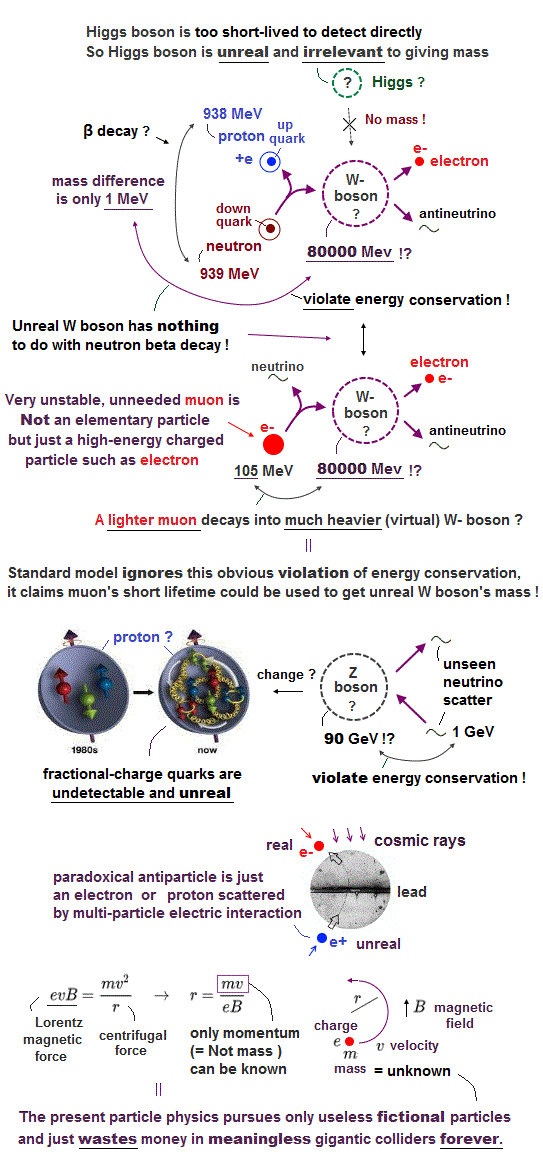
Mass defect in nuclear attractive binding energy can be explained only by the realistic Coulomb charge caused by the medium density difference.
The present paradoxical Einstein relativity ignoring the medium and unphysical quantum field theory based on unreal virtual photons are unable to explain the rest mass defect in nuclear potential energy.
This realistic Coulomb electric charge caused by the medium's density difference can naturally explain this rest mass energy defect in nuclear or Coulomb attractive binding energy or potential energy.
As shown in Fig.15', when an initial static electron and a proton attract and approach each other, it lowers the potential energy (= the medium's density imbalance decreases ), and decreases the total (relativistic) mass energy (= Maxwell's mc2 ), while the electron's and proton's relativistic mass related to kinetic energy paradoxically increases.
In the realistic Coulomb electric charge model, the negative electron closer to the positive proton decreases the imbalance in the medium's density, which decreases the resistance and the total mass (= resistance against the medium ) energy naturally.
When an electron completely overlaps a proton, the medium density imbalance is completely gone (= but particles' kinetic energy is left, so charges are stable ), which means zero rest mass energy (= the original medium state, but this case increases the medium's substance kinetic energy, to total energy is conserved ).
Realistic Coulomb electric charge in the medium is stable.
Electric charge caused by the medium's density can explain why Coulomb potential energy is changeable into light wave energy.
(Fig.16) the potential energy of medium imbalance (= electric charge ) is conserved.
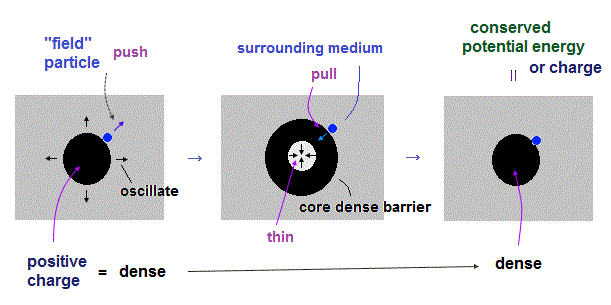
Coulomb electric charge caused by imbalance in the medium's density is stably kept by energy conservation law.
The reason why only the definite elementary charge value (= -e or +e ) is allowed is thought to be due to the property of the medium (= field ).
The stable conservation of the electric charge (= medium density difference ) needs the enough amount of medium's density imbalance.
The medium's substances constituting each charge whose potential energy stored as the medium's density difference are regularly oscillating outwardly and inwardly like the stable oscillating spring (= this medium's oscillating energy or electric charge is stably kept or conserved ), colliding with the surrounding medium.
So the medium's density difference or imbalance is stably kept as the oscillating energy, which can explain why Coulomb electric charges are stable.
Electric charge's (= medium's density ) oscillation is potential energy
When the positive (= higher dennsity ) and negative (= lower density ) charges are separated by a long distance, the medium's density difference between each charge and its surrounding medium is large, which causes larger medium oscillating energy (= colliding with the medium ) or higher Coulomb potential energy.
When the distance between positive and negative charges is longer, the Coulomb potential energy is higher, which can be naturally explained by the medium's density difference.
When the positive charge (= higher density ) is far away from the negative charge (= lower density ), the positive charge's higher-density medium's substances collide with their surrounding medium more vigorously which causes larger oscillating energy or potential energy (= larger density difference in the medium ).
When the positive charge (= higher density ) gets closer and attracted to the negative charge (= lower density ), which reduces the medium's density difference (= potential energy ), the initial higher potential energy (= larger medium's density imbalance ) is changed into the charge's kinetic energy (= de Broglie wave oscillating energy ) which can be changed into light wave energy.
↑ So the medium's substances comprising a proton an an electron are always moving and oscillating at as fast as (= or slightly faster than ) light speed c (= causing Coulomb potential energy ), which kinetic energy of the substances (= moving around at light speed ) do not change when the kinetic energy of the proton and electron (= moving far slower than light speed c ) changes, which means kinetic energy of an electron and a proton is just de Broglie wave's frequency energy (= influencing Maxwell's mc2 energy ) rather than the medium's subctances' velocity change.
Why only charge of "e" instead of 1/2e, 1/3e is allowed ?
If the amount of the charge (= medium density difference ) is smaller than e, the surrounding medium can easily enter and break the core medium's barrier (= smaller charge ) during this oscillation.
If the amount of charge is larger than e, no more surrounding medium can join the already-maximum-dense core medium (= charge ), hence, the charge cannot be bigger than e.
So the definite charge e is determined by the medium's property.
True mechanism of Lorentz magnetic force.
Lorentz magnetic force is caused by the movement of electric charge influencing electric field's density.
(Fig.17) ↓ Electric current I (= positive charges are moving and negative charges are at rest ) generates magnetic field B that exerts Lorentz magnetic force F on an external positive charge (= e+ ) moving at a velocity v
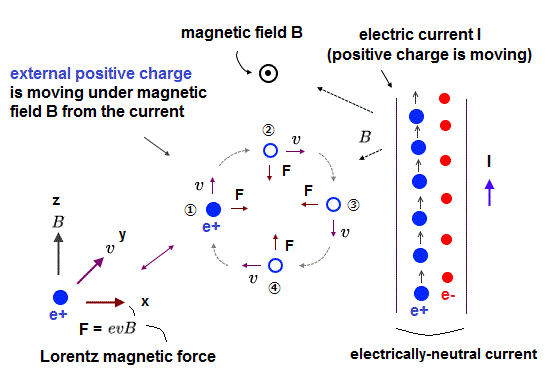
In the realistic world, there is No magnetic charge or monopole, hence, magnetic field B or magnetic force is related to the electric force, when charges are moving.
In the upper figure, positive charges (= +e ) are moving upward (= negative charges e- are supposed to be at rest ) as the electric current I.
This electric current I generates magnetic field B that causes Lorentz magnetic force on an external positive charge (= e+ ) moving at velocity v.
↑ This external positive charge is moving in circular orbit under magnetic field at constant velocity v.
We can explain the realistic mechanism of this ordinary magnetic field B and Lorentz magnetic force by using the real medium.
Electric field in the moving direction of charges is stronger, which causes magnetic force.
When a positive charge is moving as the electric current, the positive electric field in its front region is stronger due to denser medium, and the positive electric field in the back region is weaker due to diluted elongated medium, which causes magnetic force.
(Fig.17') ↓ Real mechanism of Lorentz magnetic force.
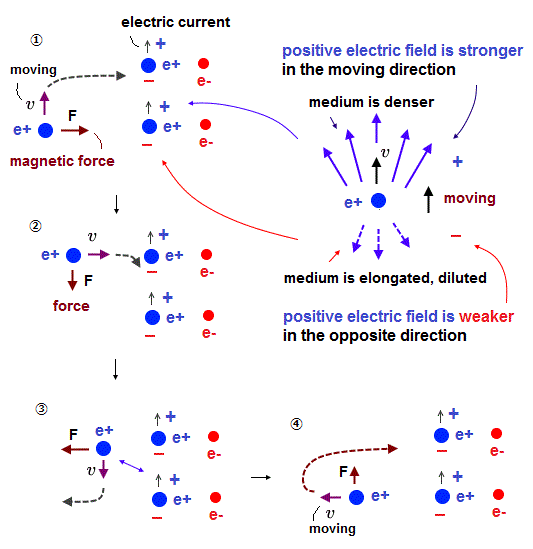
Magnetic force can be explained by electric force.
Here we explain realistic mechanism of Lorentz magnetic force without using unreal virtual photons of the current unphysical mainstream quantum field theory.
The electric field caused by the electric charge can be realistically explained using the medium's density difference.
When a positive charge (= +e ) is moving, the positive electric field in the moving direction (= front region ) tends to be stronger due to the denser medium pushed by the moving charge, while the positive electric field in the opposite direction (= back region ) becomes weaker due to the diluted, elongated medium caused by the charge moving away.
When an external positive charge (= e+ ) is moving upward at a velocity v (= ① ) at the left side of the electric current (= current direction is also upward ), this positive charge tends to be attracted to the back part with weaker positive electric field of the current charges (= attracted toward the current by Lorentz magnetic force F ) and be moving away from the stronger positive electric field region (= the front part of the current moving charges ).
↑ But of course, the average electric current is electrically-neutral (= consisting of the same amount of positive protons and negative electrons ), hence, the external positive charge can neither be accelerated nor increase kinetic energy, hence, this Lorentz magnetic force perpendicular to the moving direction of the charge cannot be exerted on the charge in the moving direction or accelerate it due to energy conservation law.
When the external positive charge is moving toward the electric current, this positive charge tends to be attracted toward the weaker positive electric field by turning downward (= ② ).
When this external charge is moving downward, it tends to crash into the stronger positive electric field of the front region of the current charges approaching, hence, this external charge tends to be moving away from the current (= ③ ) by Lorentz magnetic force.
When this external charge is moving away from the current, again, it tries to go after the weaker positive electric field of the back part of the electric current's charges and move away from the stronger electric field of the front part of the current charge, hence, the external positive charge turns upward by Lorentz magnetic force (= ④ ).
This is the true mechanism of Lorentz magnetic force which is caused by the medium density change (= causing electric charges ) around moving electric field or charges.
In case of Faraday's induction law, the amount of the electric current I is increasing and accelerating, which generates much weaker or stronger positive electric fields around the current moving electric charges, hence, it can eventually accelerate the external positive charge by the accelerating magnetic field.
Quantum gravity (= 10 dimensional string ) is unreal !
The only unified theory including "gravity" needs fantasy 10 spacetime dimensions !
(Fig.18) Graviton can cause "time dilation" ? What mechanism ?
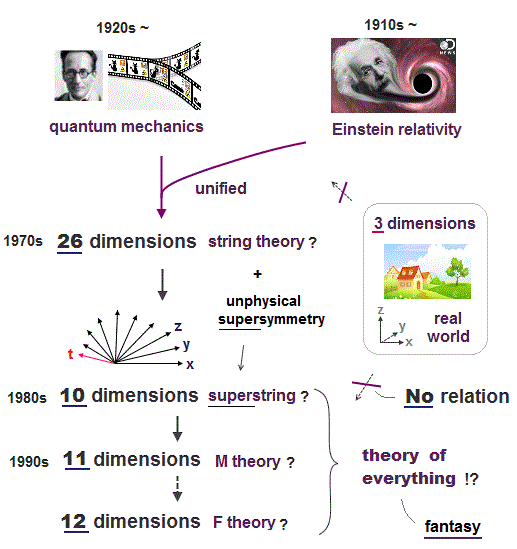
The present only theory of everything allegedly unifying (fantasy) quantum mechanics and Einstein relativity is string theory or M theory which requires unrealistic 10 or 11 dimensional spacetime.
These fictitious extra-dimensional mainstream physics claims that gravity is caused by (virtual) gravitons which must move faster than light ( this lower ), which contradicts Einstein relativity, in order to escape from the black hole into outer space.
↑ So these self-contradictory gravitons are unreal, and the cause of gravitational force needs other realistic things.
Gravity is "macroscopic" effect of other fundamental forces.
Very weak gravity is caused by low and high pressure fields' "tangle".
(Fig.19) Field "imbalance" and their oscillation cause macroscopic gravity.
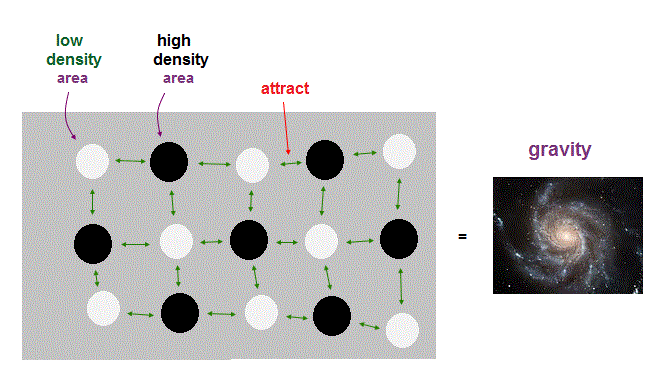
It is known that gravity is extremely weaker (= about 10-39 times Coulomb force ! ) than other fundamental forces. So it is natural to think gravity is NOT fundamental force but some macroscopic effect of other forces.
We can explain the Coulomb mechanism using "field density" imbalance.
Basically, "field" tends to be uniform in pressure, so high and low pressure regions attract each other.
We can think gravity as large-scale imbalance in field's density (= medium filling all space ). If there are higher (= denser ) pressure areas, they tend to approach lower pressure areas.
↑ Each star consists of many different atoms with different interatomic distances, so (weak) gravity is generated by slight average density difference (= combining many atoms ) in the medium where slightly high or low density (= lower density area pulls substances in the medium around the star ) areas alternate, pulling other masses or stars by their vibrations synchronizing.
When a large number of the same kind of field attraction synchronize, it generates "gravity", as macroscopic effect. This idea is more natural than other "fantasy" 10 dimensions and graviton.

Feel free to link to this site.