Home page
Quantum computer is useless
Satellite quantum computer is fake
Boson sampling = No quantum advantage
(Fig.1) ↓ A photon or very weak light is too easily lost. which makes it impossible to scale up photon or optical quantum computer.
Photon or optical quantum computers using weak classical light or a photon's state as a qubit 0 or 1 that are easily lost, are one of the most overhyped hopeless useless technologies.
Due to massive photon loss, a photon quantum computer still has less than only 4 ~ 8 impractical (photon) qubits (= one qubit takes only 0 or 1 value ), which are far from a practical quantum computer needing millions of qubits.
This p.1-left-2nd-paragraph says -- Photon loss
"However, as in other experimental platforms, one of the
main obstacles to implementing a large-scale quantum
device to perform interesting quantum information
processing is noise; especially, photon loss"
This-photonic qubits (2025) say -- Useless photon qubits
"though still face challenges in achieving reliable two-qubit gates and photon loss control." ← Impractical photon quantum computers due to easy photon loss.
This or this-Losses in optical components (2025) says -- Massive photon loss
"Photon loss is a very persistent issue in photonic quantum systems. Every mirror, beam splitter, and waveguide introduces some level of attenuation, and over multiple operations, these losses can become significant. In a quantum computer, losing even a single photon can mean losing the quantum information it carries, which results in computation errors...
the challenge remains when scaling up to larger systems."
This or this-site (7/2026) says ↓
5th-paragraph says -- Even 2-qubits are impossible
"A major challenge is that photons do not naturally interact with each other, making two-qubit operations difficult." ← Even just 2-photon-qubit operation is difficult, so building a photon quantum computer is definitely impossible.
7th-paragraph says -- Photon loss challenge
"Both approaches face the challenge of photon loss. Unlike other qubit types, a lost photon cannot be reset or recovered, making loss reduction a central focus of photonic quantum hardware development. "
4th-paragraph says -- Photons cannot stop
"Those photons are your qubits —.. photons are constantly moving. You can't just park them and wait." ← Dealing with the constantly--moving photons is extremely difficult.
5th-paragaraph says -- No 2-qubit gate
"The catch: because photons barely interact with anything, including other photons, getting two photons to interact with each other to produce a two-qubit gate is genuinely hard."
10th-paragraph says -- Significant photon loss
"Photon loss is the single biggest technical challenge. Every beam splitter, waveguide, coupling, and connector introduces loss — meaning photons (and the quantum information they carry) simply disappear."
"Photon loss is such a big hurdle because in photonic quantum computing each photon is like a unique playing card in a very fragile magic trick: if even one card quietly falls out of the deck, the whole trick stops working and you usually cannot even tell exactly where it went wrong."
"Photon loss is still quite significant, with nearly 30% of photons generated either not detected or lost, so if the loss of a single photon can be catastrophic to a given algorithm, losing 30% is essentially a non-starter."
"Fault-tolerant photonic computing requires loss thresholds below roughly 0.1–1% per operation so a lot of engineering work still needs to be done."
↑ Due to massive loss of photons (= weak light ) and the impossible two-qubit gate operation (= connecting even 2 photon qubits is impossible ), photon-qubit quantum computers are impractical forever, cannot be scaled up
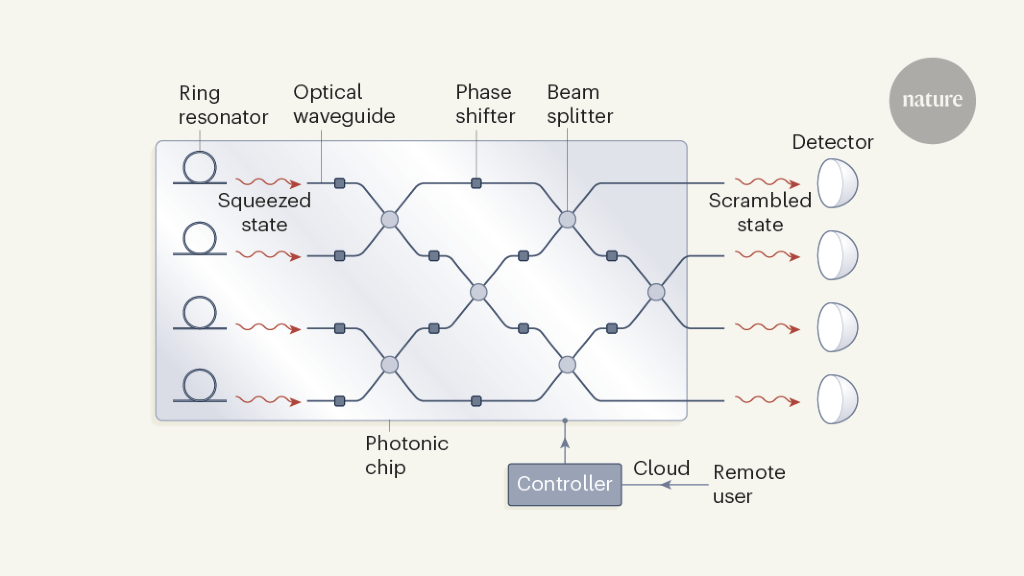
The alleged photon quantum advantage by Xanadu and China is fake, useless, just randomly detecting photons (= called boson sampling baselessly assuming these photons split into many parallel universes at beam splitters that may be hard for a classical computer's single real world to emulate ) without meaningful computation nor error correction
PsiQuantum repeatedly spread overhyped fake news of millions of qubits in near future, even by moving goal posts, though the fraudulent PsiQuantum still has No working quantum processor ( this or this-the capital destruction ).
(Fig.1') Photon quantum computer is impractical forever.
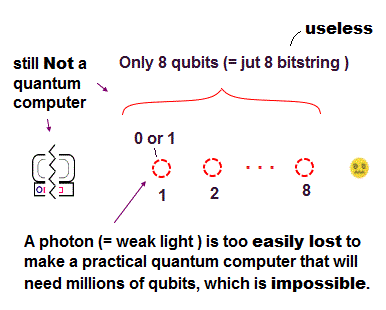
Due to this severe photon (= weak light ) loss, even the recent photon quantum computer (= still Not a computer ) has only 8 impractical qubits (= one qubit can take only 0 or 1 ), which fall far short of practically-required millions of qubits ( this or this-4th-paragraph ). ← furthermore, their 2-photon-qubits are hard to connect.
The 7th paragraph of this or this-site says -- Fake room temperature photon
"Current hype around photonic is that photon qubits do not need to be cooled,...
However, the components used to manipulate and detect photons, such as waveguides, beam splitters, and detectors, often rely on materials that require cryogenic temperatures."
Due to massive loss of photons, even 4 photon qubits are almost impossible to make.
This recent hopeless photon quantum computer (7/2026) ↓
p.1-abstract says -- Useless 4 photon qubits
"Here, we demonstrate.. up to four
qubits. We achieve fidelities of FStar = (83.5 ± 1.8) % and FLin = (75.6 ± 1.1) % for four-photon" ← Just 4 photon qubits caused high error rates (= 100% - fidelity ) of 25%, completely impractical.
p.3-left-Results say -- Too slow due to photon loss
" We obtain a direct fidelity estimation.. at
rates of 12.1 mHz and 13.3 mHz (= too slow ! )"
↑ Due to massive loss of photons (= weak light ), they could barely detect 4 photons at the very low rate of just 12 mHz or 12milliHerz (= measure photons just 12 times per 1000 seconds ), which is too slow and impractical.
This or this or this news on another overhyped hopeless photon quantum computer (8/2026) ↓
6th-paragraph says -- 2 photon qubit gate is impossible
"Two photons, by contrast, pass right through each other. Creating a two-qubit entangling gate on a photonic chip requires either a lossy nonlinear medium or a probabilistic linear-optical scheme that succeeds only a fraction of the time." ← Two-photon-qubit gate is impossible.
7th-paragraph says -- Detecting 16 photon qubits is impossible
"If you want to entangle two photons, you might succeed on the second or third try. If you want to simultaneously entangle sixteen photons into a single GHZ state (= making all qubits 0 or 1 states ), the probability of all sixteen arriving at the right place in the right state at the right time drops to essentially zero."
"This is why the prior on-chip record was four photons, and why nearly all photonic chip demonstrations to date work with two-photon or at most four-photon states." ← Just 4 useless photon qubits are the maximum
9th-paragraph says
"A photon traveling through a silicon waveguide chip can be routed through many distinct waveguide paths. Each unique path is a distinct quantum basis state. A photon in a superposition of N distinct paths represents a qudit — a quantum system with N distinct levels, carrying log2(N) qubits of quantum information."
10th-paragraph says -- 4 photons = 16 qubits ?
"Four photons then encode 16 qubits — without requiring those photons to interact with each other."
14th-paragraph says -- Detecting just 4 photons is difficult
"A four-fold coincidence rate of just 12.1 millihertz" ← Detecting 4 photons coincidentally at the very low rate = only 12 times per 1000 seconds due to severe photon loss.
20th-paragraph says -- No error correction
"through post-selected operations that can be tried multiple times until they succeed" ← Just discarding erroneous results without error correction
6th-last-paragraph says -- Fake 16 qubits
"High-dimensional encoding mitigates the photon-number problem (fewer photons needed for the same qubit count) but does not directly address the loss-per-photon problem. A photon carrying four qubits is still one photon that can be lost — and losing it means losing four qubits at once rather than one."
↑ So even now in 2026, researchers could barely detect only 4 photons (= just 4 qubits, 16 qubits are fake ) at the very low rate, which is impractical forever.
(Fig.M) ↓ PsiQuantum's million photon qubits is overhyped fake news.
The 1st, 6th paragraphs of this or this-(2025)
say -- Million qubit lie
"PsiQuantum has announced that it has raised $1 billion of Series E funding to further its goal of building fault-tolerant quantum computers at the scale of one million qubits." ← lie, impossible
"Only building the real thing - million-qubit-scale, fault-tolerant machines - will unlock the promise of quantum computing," ← Million qubits are necessary for a useful quantum computer, which is impossible to realize forever.
↑ Even today's largest (impractical) photon quantum computer has only 12 qubits in Xanadu ( this or this-2nd-paragraph in 2025, this-insider brief ), which is far from millions of qubits.
This-abstract-lower (2025) says -- Only 4-qubits
"For 4-qubit states, our circuits achieve
success probabilities of 2.053×10⁻³
" ← Just detecting 4-photon-qubits is too difficult with very low success rate of only 0.002053 due to massive photon loss.
↑ Xanadu's latest research paper in 2025 ( this or this-p.63-Figure S28 ) says probability of detecting just 5-photons (= 5 qubits ) is extremely low = only 0.000047.
Even the overhyped PsiQuantum's latest research could barely detect only 4 photon qubits ( this or this-p.5-right-3rd-paragraph, this-p.24-Fig S22 ). ← completely useless, just wasting moneyPhoton qubit numbers of fake quantum advantage, which just randomly detected photons without quantum computation nor error correction, are Not real qubit numbers.
(Fig.2) A photon or very weak light is too easily lost. which makes it impossible to scale up photon or optical quantum computer ↓

Photon quantum computer tries to use a fictional photon particle or weak light as a quantum bit or qubit.
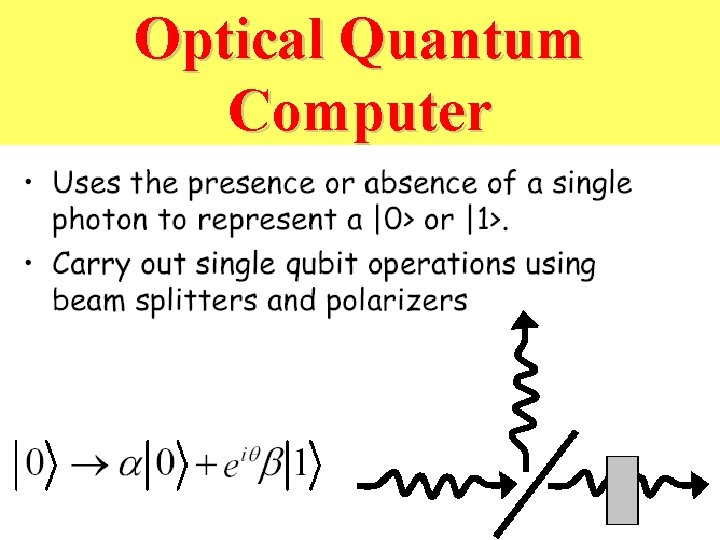
Each photon or light's polarization is often used as a qubit state (= vertically-polarized light is used as a qubit's 0 state, horizontally-polarized light is used as a qubit's 1 state ).
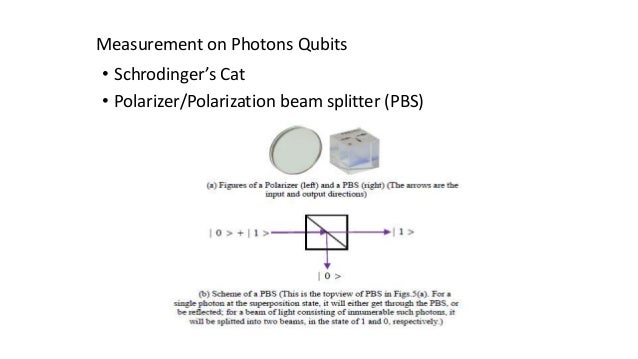
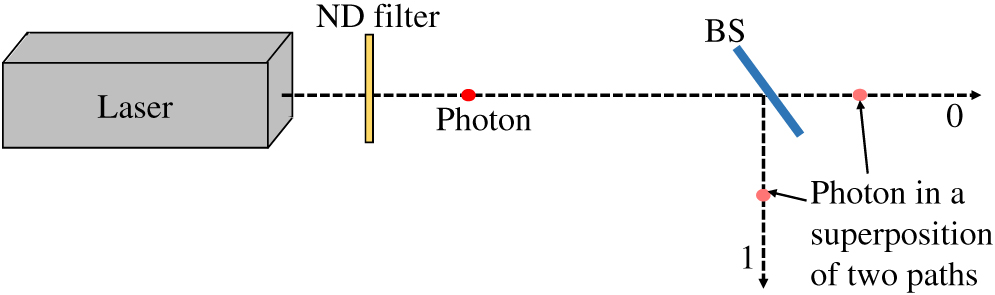
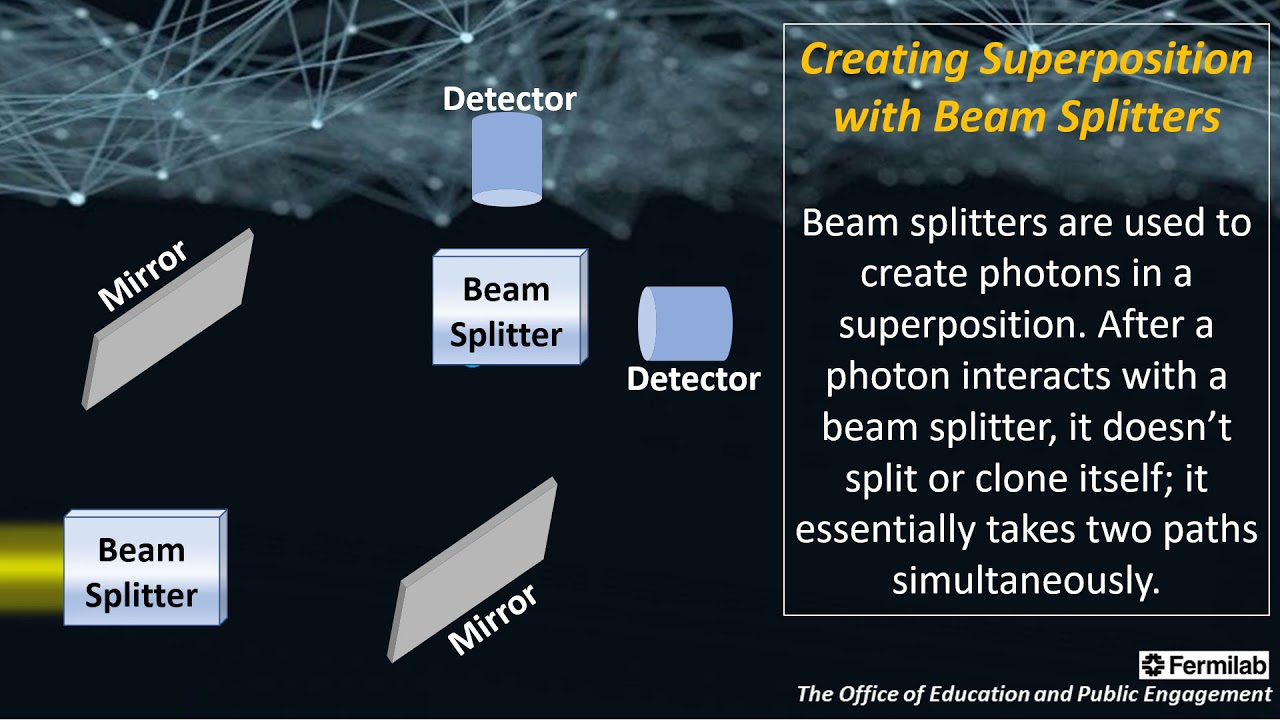
In a photon quantum computer (= still Not a computer ), when each photon or weak light splits at a beam splitter (= BS ) into the upper path (= upper waveguide ) or the lower path, these paths or waveguides are used as a photon qubit's two states (= each qubit can take 0 or 1, a photon in the upper path means a qubit's 0 state, a photon in the lower path means a qubit's 1 state, this p.1-Fig.1, this-Figure 1, this or this-2nd-paragraph ).
When a photon (= just weak divisible classical light wave ) magically splits into both upper and lower paths at a beam splitter, it is treated as quantum superposition where each photon can be both in the upper and lower paths simultaneously using fictional parallel worlds ( this p.35-Fig.3.5 ).
↑ Of course, this quantum superposition or parallel worlds are just fiction.
A photon is just a divisible weak light that can realistically split at a beam splitter.
This or this-9th, 11th paragraphs say -- Unreal photon superposition
"Then, photons are moving inside a waveguide in one direction (could be compared to plumbing pipes where you send water in). Each waveguide is called a mode, the unit of light in each mode is used to represent a qubit, two modes and one photon can encode 1 qubit. Imagine the modes as two parallel lines where the photon can be either on the upper line or the bottom line. At this point we can agree that having a photon on the upper waveguide corresponds to qubit in state |0> and the lower waveguide corresponds to qubit in state |1>, and this is the general idea that defines our qubits. We call it dual-rail encoding"
"For instance, assume we have |0> how do we end up in a quantum superposition ? ..
Once the single photon passes into a beam splitter it will move randomly in the upper or lower mode with a 50–50 chance. Furthermore, we might need different probabilities for example 30–70% or 40–60%, in that case we must have more sophisticated beam splitters using phase shifters (also called unbalanced beam splitters)."
(Fig.3) Photon qubits (= just weak classical light ) are too fragile, lost too easily to be a practical quantum computer ↓

The problem is a fragile photon or weak light so easily gets lost that quantum computers using such unstable photons as qubits are impractical forever ( this or this-4th-paragraph, this or this-p.5-right-4.4, this or this-p.1-left-2nd-paragraph ).
This-middle Photonic networks say -- Photon loss error
"Unlike with other qubit technologies, two-qubit gates in photonic networks are probabilistic (= random, causing errors ), not deterministic."
"..However, fidelity at scale is a significant hurdle for photonic networks. The largest source of error for photonic networks is photon loss during computations."
This or this-Challenges of Photonic Quantum Processors say -- Photon loss
"Losses: Photons are easily lost, limiting the performance of photonic quantum processors.
Control: It is difficult to control photons' behaviour, making it challenging to perform complex quantum operations.
Error correction: Quantum computers are susceptible to errors, which means that error correction techniques need to be developed to ensure the accuracy of calculations."
This or this-2nd-paragraph says "One of the main challenges in photonic quantum computing is the loss of photons"
This-p.1-right-2nd-paragraph says -- Photon loss
"The remaining criteria are harder to satisfy because photons don’t easily interact, making deterministic two-qubit gates a challenge (= still useless, because changing a qubit based on another qubit state = two-qubit gate operation needed for computation is impossible ). Among the additional technical considerations is photon loss,.."
".. And although photons are always flying, computing and networking tasks may need them to be delayed or stored (= usually very long bulky light cables to confine the always-flying photons or light are needed ), so an extra device—an optical quantum memory (= still impractical ) —may sometimes be needed."
↑ The impractical photon quantum computer with easily-lost photons ( this p.1-right-1st-paragraph ) motivated physicists to focus only on detecting meaningless random photons (= just divisible weak classical lights ) in fake quantum advantage.
Due to the significant photon loss, the speed of detecting (easily-lost) photon qubits is much much slower (= only 10 Hz = only 10 photon qubits can be detected per second, impractically slow ) than other ( superconducting ) qubits (= 1.4 MHz = 1400000 Hz ), as shown in this or this-Platform's table~.
(Fig.4) Photon quantum computer cannot manipulate qubits nor calculate anything by (impractical) logic gates. ↓

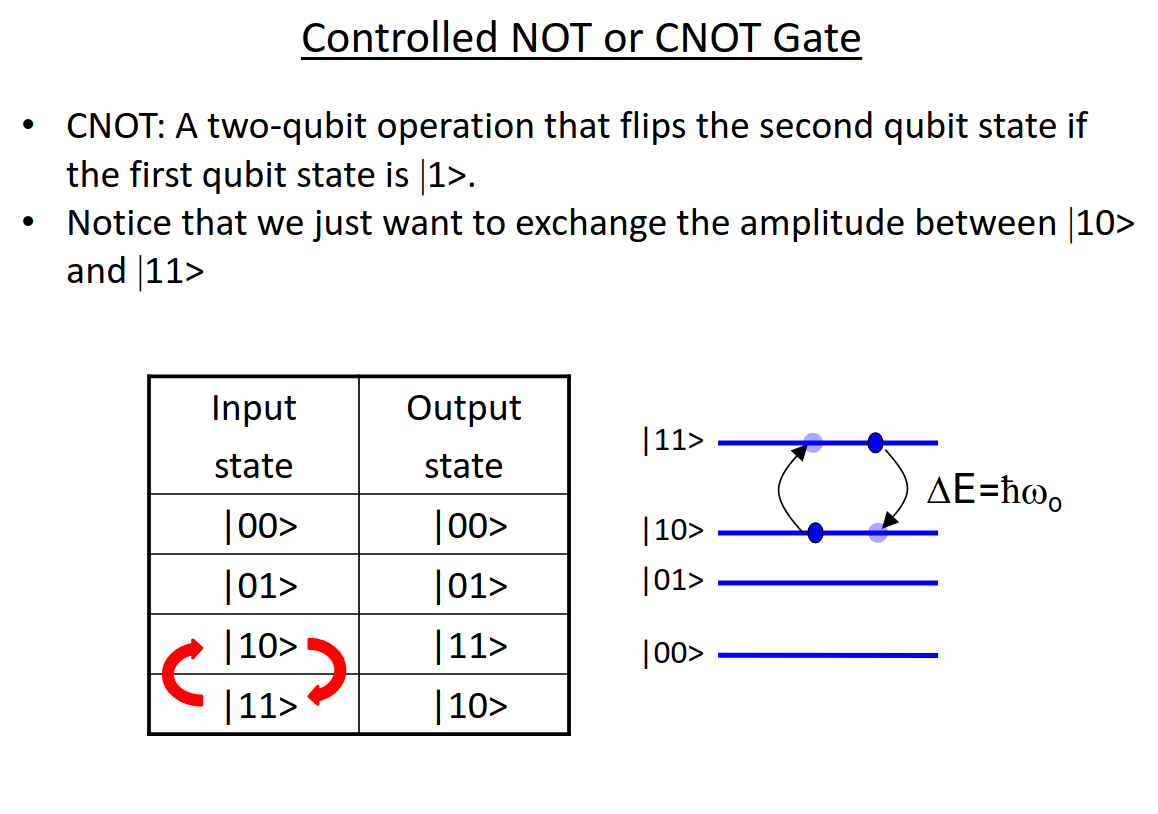
A real computer needs logic gates which change the state of a bit (or qubit ) 0 ↔ 1 by other bits (or qubits ) for calculation.
But a photon quantum computer still cannot realize even one two-qubit logic gate (= two-qubit gate operation means "change one qubit state 0 ↔ 1 based on another qubit state" ) consisting of (classical) beam splitters (= BS ).
This p.3-A universal set of quantum gates say -- No two-qubit gate
"arbitrary single-qubit operations can be expressed as combinations of beamsplitters and phase-shifters—an
optical interferometer (= for changing photon qubit state or path )...
The implementation of two-qubit gates is a challenge for photons. The fact that photons do not interact also means that it is difficult for the operation on one photon depend on the state of the other."
This p.1-introduction-1st-paragraph says -- No photon qubit gate
"in photonic systems, weak photon-photon interaction renders two-qubit gates
difficult (= photon quantum computers cannot calculate anything by conducting gate operation )"
This-paper on the hopeless 2-photon-qubit gate (8/2026) ↓
p.1-left-1st-paragraph says -- Impractical photon quantum computers
"However, in
photonic quantum information processing, a fundamental
challenge persists as the implementation of deterministic
multi-photon quantum gates remains elusive due to the
weak nonlinear interactions between individual photons. This limitation results in inherently probabilistic
gate operations, significantly hindering the scalability of
optical quantum computing system"
p.1-left-last~right-1st-paragraph says -- 75% error rate
"Nowadays, experimental implementations of CNOT
gates (= 2-qubit gate ) in multiphoton systems can generally be divided
into three categories"
"The second category improves the success probability to 1/4 by employing an additional pair of maximally entangled photons, and this approach represents the highest success probability to date"
"Beyond these basic gates, research has also extended to more complex multiple-photon gates like Toffoli and Fredkin gates, though these typically exhibit lower success probabilities."
↑ Each 2-photon-qubit gate operation's success rate is only about 1/4 (= 25% ), which 75% high error rate keeps photon quantum computers impractical forever. ↓
This or this-recent paper on (useless) photon's two-qubit logic gate (= one photon's state influences the other photon's state ) ↓
p.1-Abstract says -- Too high error rate
"The experimentally achieved efficiency in an optical controlled NOT
(CNOT) gate reached approximately 11% in 2003 and has seen no increase since (= photon's two-qubit gate operation error rate is impractically-high = 89% = 100% - 11% efficiency )..
We demonstrate a CNOT gate
between two optical photons with an average efficiency of 41.7% (= still error rate is impractically high = about 60% )"
↑ Efficiency is the success rate or the probability that a desirable photon was detected by a photodetector ( this or this-p.1-3rd-paragraph ).
This success rate (= efficiency) was still very low = only 41.7%, which is useless.
↑ So the error rate (= more than 60% error rate ) of a photon two-qubit gate operation is impractical and far worse than error rates (= 1%) of even other (impractical) superconducting or ion qubits
p.2-Fig.1 shows -- No photon computer
photon's quantum computer's two-qubit logic gate consists of (classical) polarizing beam splitters and mirrors where two lights destructively or constructively interfering determine the final qubit state (= which path photon is detected in the last ).
p.4-left-C. says "The efficiency of the gate is the probability that no photon is lost inside the gate, if one control and one target photon impinge on the gate"
p.9-left-1st-paragraph says -- 76% error rate
"Multiplying this by
the 41.7% average efficiency of the gate, one obtains a 24%
probability of detecting a two-photon coincidence per
incoming photon pair (= only 24% photons could be detected, which means the remaining 76% photons were lost, or its error rate is extremely high = 76% )."
p.9-left-2nd-paragraph says -- Massive photon loss
"obtain a naive estimate for the
two-photon coincidence rate of 10 s−1 (= only 10 pairs of photons or 10 qubits were detected per second, which is too slow and useless as a computer due to massive photon loss )"
(Fig.5) Photon qubits are too easily lost. ← Detecting multiple photons (= qubits ) simultaneously is unrealistic. ↓

To scale up photon quantum computer, physicists need to simultaneously detect as many photons (= each photon is used as a qubit taking 0 or 1 states ) as possible.
If they cannot simultaneously detect multiple photons or multiple qubits, it means photons or qubits relevant to calculations are lost (= so calculation using the easily-lost photons is impossible ), or irrelevant background photons are mixed.
So increasing success rate of simultaneous detection of multiple photons or qubits is indispensable for scaling up the photon quantum computer.
But the present simultaneous photon detection rate is too bad and too low to scale up a photon quantum computer (= even success rate of detecting only small numbers of 4 ~ 8 photons or qubits is unrealistically low and too bad ).
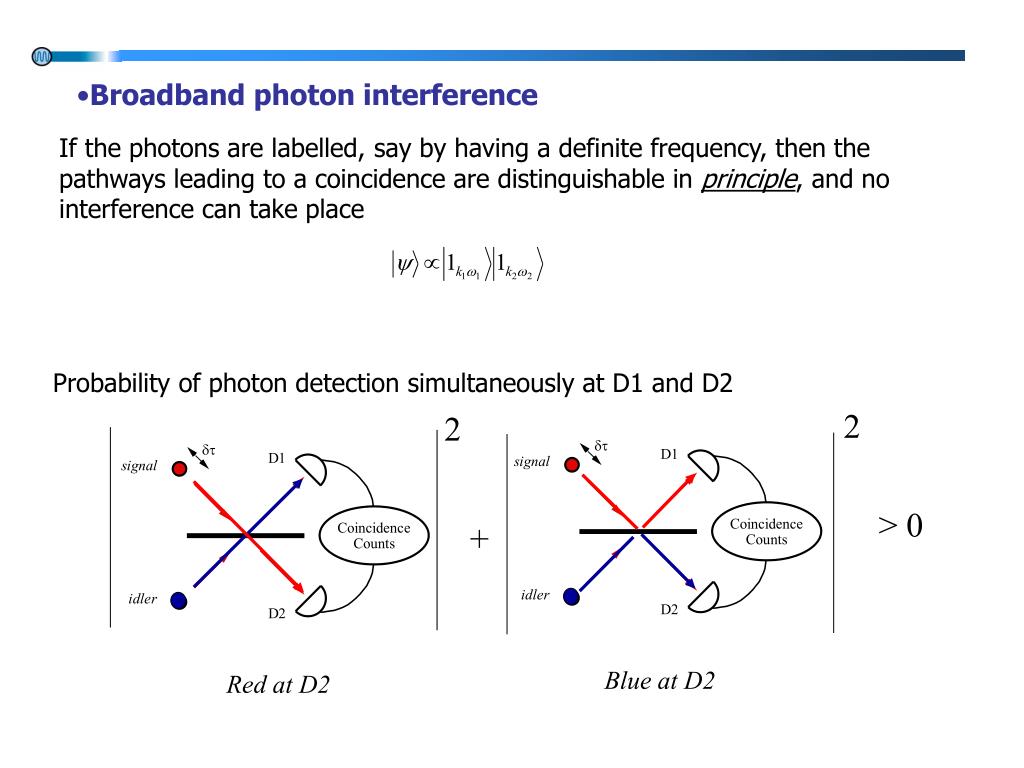
Two-coincidence (or three-coincidence ) means 2 photodetectors (or 3 photodetectors ) detect 2 photons (or 3 photons ) simultaneously ( This or this-p.12-Figure 5 ).
This or this-p.2-1.2 and p.3-2.1 say -- Simultaneous photon detection.
"If n detector events (from different
detectors
) happen within a time window of width ∆tw (called "coincidence time window" ), we call that an
n-fold coincidence. 3-fold coincidences are also counted as 3"
"Now, we want to look at 2-fold coincidences between detector 1 and 2"
This or this-p.4-left-Discussion says -- Hard to detect 4 photons
"The four-fold coincidence count in
our experiment is about three counts per hour" ← So they could detect 4 photons simultaneously at extremely-low rate of only 3 times per hour due to massive photon loss, which is completely impractical for quantum communication or internet.
p.4-right-Experimental design says "pumped by a femtosecond ultraviolet laser (390 nm, 76 MHz = 76 × 106 photons or weak light pulses were generated )"
p.5-left-last paragraph says -- Detecting 4 photons hard
"the final fourfold coincidence rate (= rate of detecting only 4 photons simultaneously ) is about 0.03 Hz (= 1 Hz or Hertz means detecting one photon per second )."
↑ It means only 0.03 photons (= 0.03 simultaneous four-photon detection ) per second were detected (= only 0.03 × 4 = 0.12 photon bits or information per second can be utilized ), which is too few and too slow to use as a computer's memory (qu)bits.
Simultaneous four-photon detection rate was 0.03/76000000 = 0.000000001 = 99.9999999 % error rate due to photons' loss, which is completely impractical.
This another recent research paper ↓
p.2-left-2nd~3rd-paragraph says "pulse laser with a repetition rate of ∼76 MHz, the QD emits ∼50 MHz polarized resonance fluorescence single photons at the end of the single-mode fiber (= about 50 MHz or 50 × 106 photons or light pulses were generated from the light or photon source )"
p.5-Fig.4a shows -- Hard to detect 6 photons
the six-photon coincidence counts (= the total number of detecting 6 photons simultaneously ) were only less than 160 per 23 hours, which counts were too few and too slow to be practical.
↑ the 6-photon simultaneous detection rate was only 160/(50 × 106 × 3600 × 23 ) < 0.0000000001, which is extremely low, and useless.
p.1-right-last-paragraph says "That is, by combining a quantum dot (QD)–based photon source, from which we measure single-photon count rates at 17.1 MHz (= 17.1 × 10⁶ photons were estimated to be generated from light source per second )"
p.5-Fig.4c shows -- 8 photon qubits hard
the coincidence 8 photon count rate drastically decreased to only less than 0.01 Hz (= less than one detection per 100 seconds ) from the original single photon rate of 17.1 MHz (= 17100000 Hz ), which means success probability of detecting 8 prepared photons simultaneously is only 0.01/17100000 = 0.000000001.
↑ Detecting only 8 photons or 8 qubits is too slow (= just 0.01 detections per second ), hence, building just 9 ~ 10 photon qubits is impossible, which is far from a practical quantum computer that will require millions of qubits.
As a result, the probability of detecting multiple photons simultaneously is extremely low and disastrous, which large photon loss makes it impossible to scale up photon's quantum computer forever.
(Fig.6) Only a few (fragile) photon qubits can be generated per second ? ← this is too slow and too impractical.
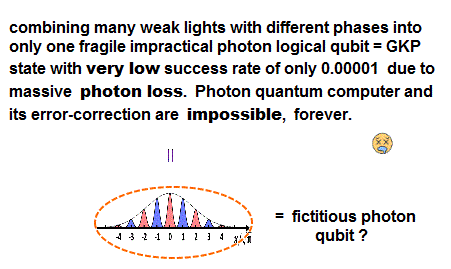
"However, a significant challenge lies in generating specialized states like the Gottesman-Kitaev-Preskill (GKP) state (= a photon's logical qubit mixing multiple weak lights or photons, this p.1-abstract ), crucial for error correction and achieving fault tolerance"
"indicating the successful projection of the last mode into a GKP state. Nevertheless, this approach is probabilistic, with a success rate as low as 1% or even lower (= photon error correction needs to create GKP light superposition state, which success rate is only less than 1%, which is useless )"
Even in the latest research in 2025, the success probability of producing this single fragile photon logical qubit (= GKP state ) just mixing multiple weak (classical) lights with different phases ( this quantum state of light ) is only 0.00001 (= 10-5 = impractically low, this abstract ) due to severe photon loss (= photon error correction is still impossible ).
↑ Photon quantum computers and their error correction (= correcting photon loss or wrong phase shift ) are impossible, unrealistic forever.
The 4th, 10th paragraphs of this or this-overhyped news (6/4/2025) say
"In this experiment, researchers used a special type of qubits known as Gottesman-Kitaev-Preskill (GKP) states, which allow many photons to encode error-free information "
"The next step, Xanadu said, is to reduce optical loss in its quantum systems ( this-last-paragraph )" ← still optical or photon's loss cannot be avoided, so useless.
↑ This research paper ↓
p.2- Fig.2-last says -- Only one qubit
"when the correct detection pattern is observed, herald the
production of a GKP qubit state" ← Xanadu tried to realize just one qubit called GKP (= a single logical photon qubit taking only 0 or 1 value, still Not a quantum computer ).
p.3-left-last says -- Low success rate
"heralded with 2.9 × 10⁻⁴
success probability (= this success rate is too low and too bad )... 30 Hz (= too slow, only 30 times per second ) success rate with the chosen discarding ratio"
p.6-right says -- Not room temperature
"The PNR detectors are based on a cryogenic transition edge sensor
design operated in a dilution fridge at 14 mK" ← Not room temperature, contrary to hypes ( this-7th-paragraph ).
The 2nd, 3rd paragraphs of this hyped news (7/14/2025) say
"The system combines quantum light sources and stabilizing electronics using a standard 45-nanometer semiconductor manufacturing process to produce reliable streams of correlated photon pairs (particles of light)—a key resource for emerging quantum technologies. The advance paves the way for mass-producible "quantum light factory" ← overhyped fake news
"This is a small step (= still unrealized ) on that path"
↑ This research paper ↓
p.9-1st-paragaph says "the photon detection efficiency (PDE). The PDEs of the idler and two signal SNSPD channels,.. to be 63% (= error rate of 37% ), 77%, and 74%" ← Error rate of detecting each photon (= one qubit 0 or 1 ) is too bad = 30 ~ 40%.
p.11-Fig.1(b) says "the entire 2 mm×9 mm electronic-photonic CMOS chip, which contains 12 photon-pair source blocks"
↑ Very bulky impractical photon chip of 2 × 9 millimeter size emitting only 12 photons (= just 12 quantum bits ).
↑ So this overhyped photon chip is useless (= commercialization is hype, impossible ), far bigger (= ~ 9mm ) and bulkier than today's practical 45nm transistors.
Xanadu photon quantum computing company is said to develop quantum computing framework for photodynamic cancer theory, which is fake and useless with No quantum computation..
This or this-hyped Xanadu quantum cancer therapy news ↓
7th-paragraph says -- Just future estimate, No computation
"Resource estimates, obtained using PennyLane (= classical computing software ), suggest simulating systems with 11-45 spatial orbitals requires 180-350 logical qubits,,, indicate the feasibility of running these algorithms on future (= still unrealized ), realistic fault-tolerant quantum devices."
↑ So this research just vaguely estimated how many (logical) qubits will be needed to calculate some photosensitive molecules (= whether these are used for cancer theory is unclear ) in future with No actual quantum computation.
↑ Actually, still No single errorless logical qubit has been realized (= one logical qubit taking only 0 or 1 value must consist of more than 1000 physical qubits, this or this-18th~20th-paragraphs ), and it is extremely difficult for the useless photon quantum computer to have more than 4 physical qubits due to photon loss, so quantum computation for cancer-related molecular energy is impossible. ↓
↑ This paper on Xanadu's fake quantum cancer therapy ↓
p.1-abstract says -- Just estimation, No computation
"Our resource estimates, obtained with PennyLane, suggest that systems with
active spaces ranging from 11 to 45 spatial orbitals can be simulated using 180-350 logical qubits" ← This research just roughly estimated how many logical qubits will be necessary in future without actual quantum computation
p.3-Table I says -- No quantum computation
"Resource estimates (= just estimation without actual quantum computation ), obtained with PennyLane (= classical computing software ), for cumulative absorption using the threshold projection algorithm.. evaluated across active spaces of N spatial orbitals for several BODIPYclass photosensitizer molecules"
p.8-left-last-pargraph says -- No quantum mechanical prediction
"This is a reasonable
assumption, given the well-known capability of classical methods such as DMRG (= approximate CI, this-p.13-5th-paragraph ) or selective configuration
interaction (= CI )"
↑ Configuration interaction (= CI ) and DMRG is the impractical quantum mechanical variational method just choosing fake trial wavefunction for unsolvable Schrodinger equation that cannot predict anything.
↑ So this research just estimated how many (logical) qubits (= one logical qubit can take only 0 or 1 value ) will be needed in the future in still-non-existent quantum computer to calculate energy of photosensitive molecules (= still No calculation of specific energy in this research ) with the help of a classical computer, which cannot predict anything nor cure cancers due to the impractical quantum mechanical unsolvable Schrodinger equation.
↑ Xanadu (= still having No useful quantum computers ) and Mitsubishi just roughly estimated how many qubits will be needed in future to calculate some lithography-related molecular energy with No quantum computation and No quantum mechanical prediction (= due to the unsolvable useless Schrodinger equation ).
↑ This Xanadu-Mitsubishi's paper ↓
p.1-abstract says -- Just estimation, No computation
"Additionally, we provide logical resource estimations for a
model photoresist monomer, 4-iodo-2-methylphenol (IMePh), and demonstrate that 92 eV absorption sensitivity can be resolved using roughly 200 logical qubits" ← This research just roughly estimated how many logical qubits will be needed without quantum computation.
p.5-right-1st-paragraph says --
Classical computer needed
"In the first step of the algorithm, we may choose
from any standard technique for preparing an approximate ground state on a
classical computer,
such as the density matrix renormalization group
(DMRG) method (= approximate variational CI ) or selected configuration
interaction (= CI ). We assume the use of a Gaussian type orbital (GTO) basis set, but the algorithm
will work for any choice of basis."
p.5-right-2nd-paragraph says
"We then take this dipole-acted state and prepare it on a quantum computer"
p.16-left-2nd-paragraph says -- No quantum mechanical prediction
"The model system is constructed as follows: first,
the Hartree-Fock orbitals for the IMePh molecular
system were obtained in the def2-SVP basis set and
corresponding effective core potential. Next,
an active space was built" ← Just choosing fake trial wavefunctions or basis sets for unsolvable Schrodinger equation in quantum approximate Hartree-Fock method that cannot predict anything
p.17-right-2nd-paragraph says -- Just estimation, No computation
"A summary of the resource estimates can be found
in Table III for the all-electron system. Additionally, for the following results, we assume that we
can reduce the number of electrons in the simulation from the all electron approach at η = 110, down
to η = 58, using pseudopotential based methods." ↓
↑ So this overhyped Xanadu's research just used a classical computer to calculate some lithography-related molecular energy by choosing fake trial basis set wavefunctions and active space for unsolvable Schrodinger equation that cannot predict anything.
And quantum computers needed to estimate excited states of those molecules still do Not exist. So they just roughly estimated how many qubits will needed in future without quantum computation.

Feel free to link to this site.