(Fig.1) The (fictional) gravitational wave could change the LIGO 4km-arm by only 1/1000 of a tiny proton's radius ? ← This change is too tiny to measure. so No evidence of gravitational wave, which is useless.
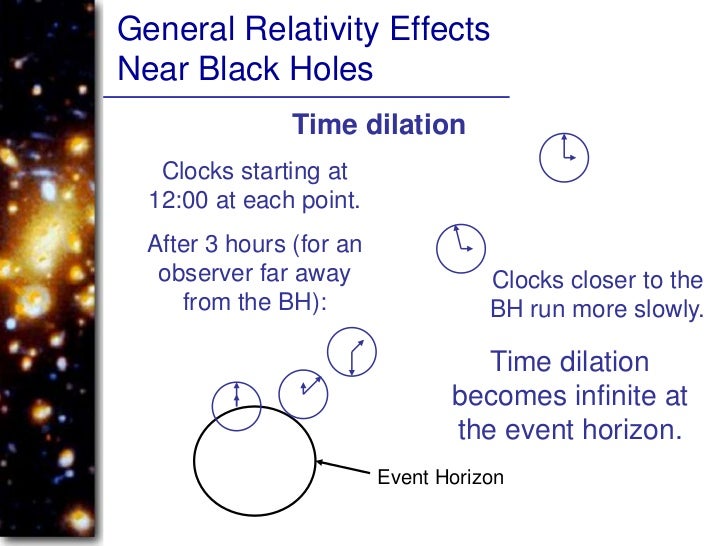
Gravitational wave allegedly emitted by merger of black holes is unreal, because the time stop around the black holes (= all things' motions stop ) prevents black holes from merging, spinning and forming, as seen by distant observers on the earth ( this or this-4~5th-paragraphs, this or this-2nd-paragraph ).
The gravitational wave, which is too weak to measure, is said to change the LIGO 4km arm by only 1/1000 of a proton radius (= unrealistically-small, only 10-18 m change compared to the tiny proton's radius of 10-15 m, this or this-p.23-p.24, this-7th-paragraph ).
This or this-5th-paragraph says -- Too small gravitational wave
"To spot gravitational waves directly for the first time, scientists had to measure a distance change 1,000 times smaller than the width of a proton using interferometers, basically mirrors placed 4 kilometers apart."
↑ The wavelength of light (= about 10-6m or 1 μm ) used for detecting this (illusory) tiny gravitational wave by interference is much, much longer than the proton radius ( this-8th-paragraph, this p.3-4th-paragraph, this p.12-last-paragraph ), which cannot detect such a tiny gravitational wave's change by light interference.
These too weak useless (illusory) gravitational waves are said to change the length between the earth and Sun by only one hydrogen atomic radius ( this 5th-paragraph, this-p.1-4th-paragraph ), which is impossible to measure except in the hyped news.
This LIGO-gravitational wave paper ↓
p.4-left-1st-paragraph says
"The interferometer
is illuminated with a 1064-nm wavelength Nd:YAG laser" ← Detection light wavelength is far longer than the too small gravitational wave's change of 1/1000 of a proton.
p.5-right-4th-paragraph says -- Background = unreal gravitational wave
"Estimating this background is challenging for two reasons: the detector noise
is nonstationary and non-Gaussian, so its properties must
be empirically determined" ← So gravitational wave must be artificially determined by empirically removing background, which is Not prediction of gravitational wave.
(Fig.2) Gravitational wave disappearing as seen by some observers is unreal.
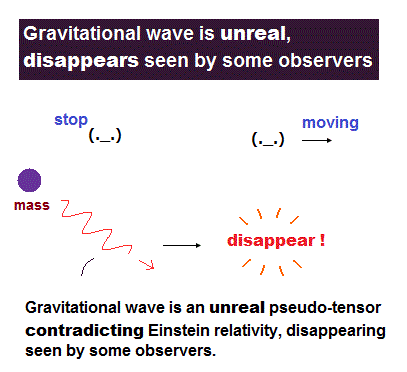
Einstein general relativity has fatal flaws, it cannot conserve energy or carry wave ( this p.5-last, this or this-p.5-last-paragraph, this p.2-(2) ).
This or this-p.16-3rd-paragraph says -- Wrong general relativity
"in GR (= general relativity ) energy-momentum is No longer conserved in
general ( this or this-1st~3rd-paragraphs )"
This or this-p.13-8th-paragraph says -- Relativity Not conserving energy
"The bottom line is that conservation of energy and momentum in general relativity is a very slippery
concept... global energy conservation does not exist in general relativity"
This-p.12-5 Discussions say -- Violate energy conservation
"the matter energy non-conservation in curved spacetime,
in particular, in general relativity... non-conservation cannot be fixed by
considering gravitational energies ( this or this-p.19 )"
General relativity unable to conserve energy is why physicists had to artificially introduce unphysical concepts called "pseudo-tensor (= Not real tensor of Einstein relativity, this 4-6th paragraphs, this or this-p.1-right-middle )" as doubtful gravitational wave which contradicts Einstein theory ( this or this-p.13-14, this or this-p.1, this p.1-middle-3rd~5th-paragraphs ).
This-p.2(or p.1 )-1st-paragraph says -- Unreal gravitational wave
"Although the dependence on the coordinate system makes it impossible to
obtain well-defined gravitational energy and momentum from the pseudotensors, they are essential in the study of the energy and momentum carried
by gravitational waves ( this-p.2-2nd-last-paragraph )"
This or this-lower-Crothers (2018).. says -- Wave contradicts Relativity
"The (gravitational) wave equation is not a consequence of GR (= general relativity ). It is a consequence of GR plus a coordinate choice."
↑ Gravitational wave is unreal, expressed as artificial pseudo-tensor with many free parameters irrelevant to Einstein relativistic prediction ( this or this-2nd~7th-paragraphs, this or this-10~15th-paragraphs, this or this-1st, last-paragraphs ).
Gravitational wave (= pseudo-tensors ) is illusion, unrealistically vanishing as seen from different coordinates or observers ! (= this or this p.19-last-paragraph, this-intro-1st-3rd-paragraphs or this-p.2-left-1st-paragraph )" contradicting Einstein original relativistic tensors.
This-p.2-1st-paragraph says -- Gravitational wave vanish
"gravitational
waves, pseudotensors globally vanish in some coordinates (= gravitational wave vanishes as seen by different observers, this-3rd-paragraph )."
This or this-p.1-3rd-paragraph says -- Pseudo-tensor vanish
"Unlike a tensor, a
pseudotensor (= gravitational wave ) can vanish at a point in one coordinate system (= seen by some observers )"
This or this-p.2-3rd-last-paragraph says -- Unreal gravitational wave
"Unlike electromagnetic waves, gravitational waves do not
possess their own energy-stress tensor... Poynting’s vector is constructed from a pseudo-gravitational tensor, which,
however, can be made to vanish simply through a coordinate transformation (= seen by some observers ).
Poynting’s vector is therefore not a true vector, and there can be neither a localization of energy in the gravitational field, nor a direction given to the flux of
energy"
↑ Because when some observers may detect gravitational wave (= fictitious pseudo-tensor ) at the detector on the earth, other observers moving differently can Not observe the same gravitational wave (= pseudo-tensor ) even by using the same detector, due to gravitational wave unrealistically vanishing seen by some observers, which is fatal relativistic paradox.
Physicists can artificially create and choose many different forms of gravitational wave's unphysical pseudo-tensors ( this p.2-lower ), which means the artificially-created gravitational wave (= unphysical pseudo-tensor), which contradicts Einstein relativity, cannot be used to test Einstein relativistic prediction.
This or this-p.5-3rd-paragraph says -- Artificial choice, No prediction
"Because there are many possible stress-energy tensors and pseudotensors (= No unique equations nor prediction of gravitational wave ), I am not
sure whether a general relationship holds between them all"
This or this-lower Limitations and challenges say -- No relativistic prediction
"because you can get different answers for the same physical situation. In different coordinate systems, the pseudotensor will produce different values for the energy and momentum of a gravitational field. Another challenge is the lack of a unique definition. Different physicists have proposed different forms of the pseudotensor (= gravitational wave ), each with its own strengths and weaknesses. This can lead to some confusion when comparing results or trying to build a consistent picture of the physics. Furthermore, due to the pseudotensor not being a true tensor,.."
Gravitational wave expressed as paradoxical pseudo-tensor unrealistically vanishes as seen by different observers or choice of different coordinates, so gravitational wave does Not exist, and general relativity is proven false.
Some physicists try to solve this problem by fabricating artificial unreal energy called "superenergy (= Bel-Robinsin ) tensor combining pseudo-tensor ( this-p.1, p.6-IV )"
↑ This ad-hoc superenergy tensor is Not real energy or momentum due to using dimensions different from real energy and momentum ( this-p.1-right-last-paragraph ).
This-paper debunking unreal superenergy tensor ↓
p.2-1st-paragraph says -- Useless superenergy
"Following the
original work of Bel, who proposed a definition of super-energy (and
“super-Poynting”) for the gravitational field, most of the previously cited authors attempted to relate this tensor to some appropriately defined concept
of energy. However, an application to concrete problems, such as the generation of gravitational radiation by a binary pulsar, has not been achieved
yet.
"
p.6-3rd-paragraph says -- Unreal dimensions
" This problem with dimensions has been noticed by most previous authors (for instance, a quantum of
super-energy should be proportional to ω3"
p.7 says -- Unreal superenergy tensor
"a fully covariant formalism based
on the Bel-Robinson (= superenergy ) tensor and applicable to practical problems, such as
gravitational radiation, is still an open problem"
(Fig.3) (Illusory) Binary pulsar B1913+16 emitted (imaginary) gravitational wave, which slightly changed the light or radio pulse ?
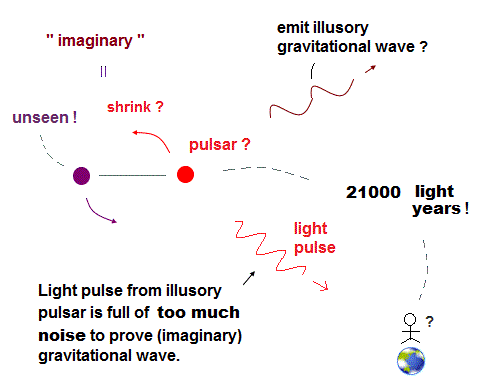
The (illusory) neutron stars or binary pulsars called PSR B1913+16 are said to gradually lose energy by emitting (imaginary) gravitational wave, which can be detected by the light or radio wave pulse emitted from these pulsars ?
But light wave pulses allegedly emitted from extremely-distant pulsars are always modified by interstellar medium and filled with too many irrelevant noise (= this-6.2, this or this-p.6-upper-noise-pulsar-picture ).
So estimating the (illusory) pulsars' orbital motion and their emission of gravitational wave from these very noisy light pulses is impossible, even after artificially trying to eliminate the (unknown) noise ( this p.37, this or this-2.1-overview ) or de-disperse with free parameters called dispersion medium (= DM ), which is Not prediction of Einstein relativity.
Actually, pulsars are Not neutron stars but some oscillating interstellar medium reflecting light pulses (= emitted from other stars ) periodically, so No relativistic prediction of gravitational wave.
After artificially removing noise by free parameters (= dispersion medium ) and noise models from noisy radio pulses (= this is Not prediction of Relativity, this-p.6, this or this-p.6-right-last-apragraph ), astronomers recklessly try to guess neutron stars' motion emitting (illusory) gravitational wave ( this or this-p.21-lower, p.24, p.32-last ) by adjusting many free unknown parameters.
For example, in the most famous binary pulsars called PSR B1913+16, a pair of neutron stars (= pulsars ) with about a solar mass are said to orbit around each other with an orbital period of about 7.75 hours and the spinning period of 59 milliseconds, which are roughly estimated from the (noisy) pulses' period.
↑ It is impossible to know two neutron stars' masses, sizes, orbital radius, orbital shape and inclination only from the pulses.
So they have to artificially determine those (illusory) neutron stars' orbital (Keplerian and post-Keplerian) parameters (= freely-adjustable parameters ) by using some ad-hoc pulsar models.
They baselessly insist these neutron stars (= pulsars ) are gradually losing (illusory) gravitational wave energy, and their orbital period is gradually getting shorter.
↑ But this orbital periodic change by gravitational wave is too small = just 76.5 microsecond (= in one orbital period of 7.75 hours ) per year ( this or this-4th-paragraph, this or this-Rate of decrease of orbital period ), which is too small to know in the originally noisy pulsars' data.
↑ Actually they officially admit there are always uncertain errors called residuals (= time difference between measured times of arrivals of pulses and the calculated times of arrival, this-p.1, p.16-lower, this or this-p.36 ), which errors are more than 100 microseconds ( this-p.13 ) which easily mask this tiny orbital change by the illusory gravitational wave and other tiny relativistic effects (= so No experimental evidence that Einstin relativity is right ).
To prove Einstein general relativity is right, physicists need to use at least 3 post-Keplerian parameters such as tiny orbital periodic change (= dot-P = just 76μs per year ) by emitting gravitational wave, advancement of periastron (= dot-ω ), and tiny gravitational redshift called Einstein (or Shapiro time ) delay (= γ, this-p.1, this-p.13 ).
↑ As I said, gravitational wave is expressed as unreal pseudo-tensor disappearing as seen by some observers (= coordinates ), which is irrelevant to Einstein relativistic prediction ( this-p.2-last-paragraph ).
The periastron of the neutron star's orbit is said to advance 4.2 degree per year by Einstein general relativistic effect ( this or this-p.15 ).
↑ It is impossible to know this advancement of the periastron without artificially determining the pulsars' orbital shape, angle and multiple too tiny doubtful relativistic effects which can Not be separated from larger classical orbital effects (= noisy pulses cannot tell us concrete neutron stars' orbital shape and inclination at all ).
The pulsars' spinning period (= 79 milliseconds = which is also a freely-adjustable parameters, because this unknown spinning period allegedly seen in noisy pulses is always fluctuating by noise, pulsars' orbital positions, and velocity ) is said to slightly slow down in the periastron where two pulsars are the closest to each other due to stronger gravitational redshift (= caused just by energy conservation law irrelevant to gravitational time dilation ), which is called Einstein delay (= γ ).
↑ This gravitational redshift allegedly caused by the other neutron star's gravity is too tiny to measure (= proportional to v2/c2, c is light speed, v is the pulsar's speed of about 300km/s in periastron ), which it is easily hidden by (= so inseparable from ) far-larger classical Doppler shift (= proportional to v/c ) or apparent pulses' frequency (= 1/unseen spinning period ) change caused by the neutron stars' motion ( this or this-6th~7th-paragraphs ).
↑ The pulsars' spinning period is said to be changed by the classical Doppler effect (= ~ 1/1000 ) which easily masks and invalidates the too tiny gravitational redshift (= 1/1000000 = this too tiny gravitational redishift cannot be distinguished from the far larger classical Doppler effect, this or this-p.5(= or p.3 )-last~p.6(= or p.4 )-upper ) and the original unknown spinning period, all of which are freely-adjustable parameters ), which means pulsars cannot prove Einstein relativity.
Relativistic Shapiro effect is also too tiny to measure, which is said to slightly delay the arrival of pulses emitted from the other side of the companion neutron star by just 0.000001 seconds (= from the original 2 second-delay ), which is too tiny to separate from the original time delay of 2 seconds (= so both this tiny relativistic Shapiro delay and the original classical orbit are free parameters ).
↑ Unless they can separate or determine each value of classical Doppler (= related to pulsars' velocity, orbital shape ), tiny gravitational redshift, advancement of periastron... independently, they cannot use those parameters to predict Einstein relativity. So No experimental evidence that Einstein relativity is right in pulsars emitting gravitational wave.
↑ These too tiny fishy relativistic effects of Einstein or Shapiro delay (= pulsar's period 79ms × 0.000001 = 0.0000001 second ) cannot be determined in the too noisy radio pulses which always include more than 100 microseond errors (= residual ).
As a result, it is impossible to know the too-tiny relativistic parameters hidden in other larger classical effects or noise ( this or this-p.4-2nd-paragraph, this or this-p.26-1st-paragraph ), so pulsars cannot predict Einstein relativity is right (= they rely on artificial pulsar models with many free-fitting parameters, this or this-p.5 ~ last-page, this-p.5 ), contrary to the media fake news.
This or this or this or this research paper about allegedly estimating gravitational wave emitted from the (illusory) distant binary pulsars PSR 1913+16 ↓
This or this or this-p.436(= or p.3 )-right-3rd-paragraph says -- Artificial model parameters
"Differences between predicted and observed values can then be used to determine corrections to various assumed model parameters." ← Each time the predicted values were wrong, the artificial model parameters were changed, which is Not a prediction of Einstein relativity.
This or this-p.441--left-2nd-paragraph & Table 5 says -- Free parameters
"as well as the number of instrumental free parameters" ← All artificial models predicting pulsars emitting gravitational wave include freely-adjustable parameters, so Not a prediction of Einstein relativity.
↑ The observed radio-wave pulses just show rough periods P, which cannot tell us actual masses m (= free parameters influencing gravitatinoal wave radiation, this-p.438-Table-2-free parameters-Y in different models, p.439-(18) ) and orbital shape of the (illusory) neutron stars (= stars of the same mass show different orbital periods depending on different orbital shapes ).
This research paper about the same pulsars ↓
p.3-3. Analysis of TOA says -- Free parameters, No prediction
"a number of nuisance parameters must also be measured to account for unmodeled
long-term timing irregularities. These extra fitted terms have No
clear physical interpretation ( this p.3 )"
p.4-last-paragraph says -- Ad-hoc unreal parameters
"The remaining timing parameters—higher-order derivatives
f¨, f¨, and (in some fits) another small frequency discontinuity in mid-1992—were introduced to the timing solution in
an ad hoc manner,... Although we offer No clear or unique physical interpretation for these parameters"
As a result, there is No evidence of gravitational wave (= artificially defined by many free parameters with No relativistic prediction ), which just contradicts Einstein relativity.
This or this-recent overhyped fake news on Einstein relativity ↓
2nd-paragraph says -- Illusory black holes.
"The signal, called GW250114, came from the merger of two black holes — each about 30 times the mass of the sun — about 1.3 billion light-years from Earth. The event caused ripples through space-time, called gravitational waves, which washed over Earth.. and were detected by.. Laser Interferometer Gravitational-Wave Observatory (LIGO)." ← wrong.
9th-paragraph says -- Fake Einstein prediction
"In GW250114, researchers detected the two primary tones predicted for such a merger. Each tone yielded an independent measurement of the black hole's mass and spin — and both matched, effectively verifying general relativity, the team reported in the study." ← false.
↑ First of all, the time stops on the surface (= event horizon ) of black holes seen from the earth, so it is impossible to measure any black hole's motions such as spin and merger from the earth through the (illusory) gravitational wave that is unreal, too weak (= 1/1000 of a proton = this or this-1st~4th-paragraphs ) to measure.
↑ This-research paper ↓
p.4-Fig.3 says -- Artificial models, No Einstein prediction
"Filtering out two QNMs in the post-merger data.... finds strong support for the 220+221 model over the singlemode 220 model. The 220+221+222 model is weakly preferred over
the 220+221 model"
↑ Gravitational wave depends on artificial model and many fitting parameters of unseen wave forms and black holes (= this-p.28-p.29, this-p.12-left-1st-paragraph, p.14-left ) irrelevant to Einstein relativistic prediction.
This-p.2-right-2nd-paragraph says -- Gravitational wave = free parameters.
"The
amplitudes An and phases φn (= of unseen gravitational wave )... so we
treat them as free parameters in our fit."
This paper on gravitational wave (= GW ) ↓
p.6-left-1st-paragraph says -- Free parameters
"In that way, the set of free parameters becomes"
p.21-left-1st-paragraph says -- Free choice of parameters
"an arbitrary choice must
be made in the injection in order for the amplitudes
and phases (or unseen gravitational wave )"
p.22-left-last says -- Noise free parameters
"the signal and noise instantiation including
nuisance parameters.. (= noise fitting free parameters ) "
↑ As a result, forms of the unreal gravitational waves (= amplitude, phase, frequency.. ) and unseen black holes (= spin, mass, motion.. ) depend on many freely-fitting parameters irrelevant to Einstein relativistic prediction, contrary to a lot of fake news.

Feel free to link to this site.