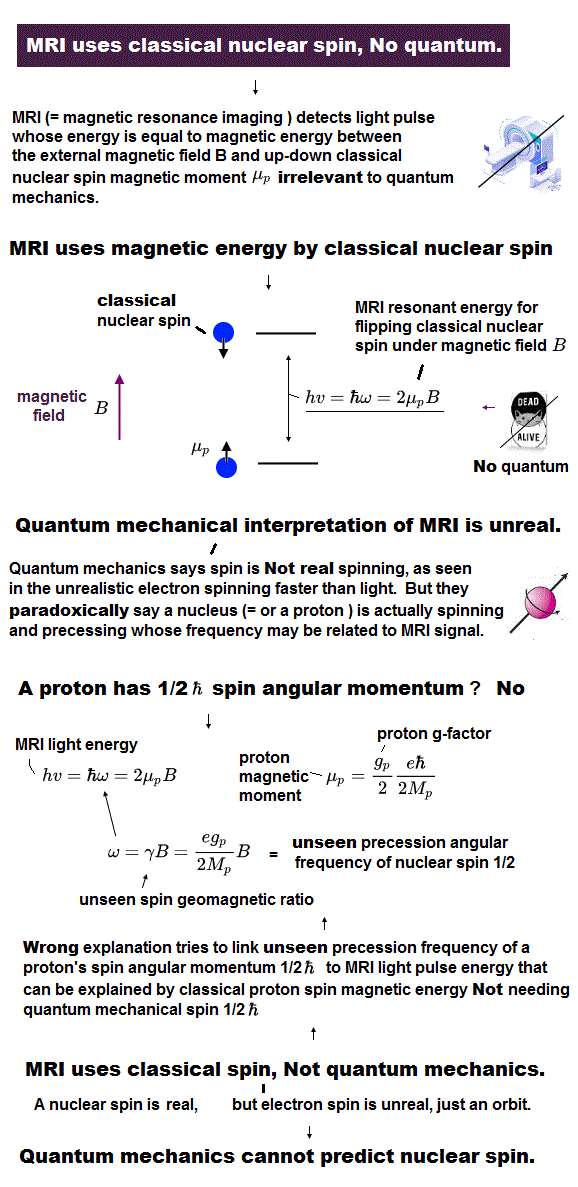
(Fig.1) MRI just measures light pulse whose energy is equal to magnetic energy between external magnetic field and classical proton's magnetic moment, No need of quantum mechanics.
MRI (= magnetic resonance imaging ) is often said to be caused by quantum mechanics, which is wrong.
We can treat a proton as a classical mechanical particle's spinning, which is different from the unreal electron spin (= a tiny electron must be spinning faster than light to generate the observed magnetic moment ) that is just a classical electron's orbit.
In MRI, they apply the light pulse whose energy (= frequency × ℏ ) is almost equal to the energy difference between up and down (= 2 × ) nuclear spin magnetic moment (= μp = experimental value with No quantum mechanical prediction ) × external magnetic field (= B ) = 2 × μpB ( this-lower, this-p.18-3.17 ) which is equal to the energy equation using geomagnetic ratio (= γ, this-p.3-upper, p.7-upper, this ).
This Resonance says -- Classical magnetic energy in MRI
"This promotes the
nuclei from low energy spin (parallel) to high energy spin (antiparallel) thus absorbing energy - excitation.
The frequency (= ν or ω of this ) required to make this happen is specific to the difference in energy between the 'parallel' and 'antiparallel"
↑ As a result, MRI does Not need quantum mechanics at all, as seen in transistors.
Quantum mechanics can Not predict proton's or nuclear spin magnetic moment that must be obtained from experimental results.
Nuclear spin magnetic moment (= magnetic field generated by nuclear spin ) is expressed as a tiny hyperfine energy level splitting between magnetic energies between nuclear spin and electron's orbits.
↑ Quantum mechanics cannot predict any energy levels or orbits of multi-electron atoms due to unsolvable Schrödinger equation.
↑ Quantum mechanical inability to predict any atomic energy levels means quantum mechanics also cannot predict hyperfine energy levels nor nuclear spin magnetic moment.
This-p.5-right-4th-paragraph says -- Choose free parameters
"The effective nuclear charge Z, has been found empirically (= Not quantum mechanical theoretical prediction ) to be approximately equal to Z for s electrons"
This-p.2-left-3rd-last-paragraph says -- No quantum prediction
"we use the core-Hartree
(CH) potential and the Kohn-Sham (KS) potential derived within density-functional theory (= DFT )" ← DFT with artificially-chosen exchange potential functionals cannot predict any energy values.
Quantum mechanics and quantum electrodynamics (= QED ) are known to be unable to predict any nuclear-related values such as nuclear spin magnetic moment.
So physicists rely on ad-hoc quantum chromodynamics (= QCD ) that just fit freely-adjustable parameters without analytical solution nor prediction.
What causes proton (= nuclear ) spin magnetic moment is uncertain (= called proton spin crisis ), which are free parameters that can Not predicted by QCD nor quantum mechanics
This site ↓
p.2(or p.1)-3rd-paragraph says -- Uncertain proton spin
"Since the remaining fifty percent spin of the proton is still missing it is known
as the proton spin crisis"
p.3(or p.2)-5th-paragraph says -- No analytical solution of spin
" However,
the analytical solution of the non-perturbative QCD is not known yet"
This-p.16-right-1~2nd-paragraphs say -- Free parameters
"estimates of fitting systematic
uncertainties in the extraction of the magnetic moments
and polarizabilities resulting from the choice of fit form"
This-p.1-left-1st-paragraph says -- Spin = free chosen parameters
"This makes the process of performing large,
correlated fits a balancing act, with many choices and
compromises to be made"
(Fig.2) In atomic clocks, only cesium atoms which are excited to slightly upper hyperfine energy levels by microwave (= whose energy or frequency is used for defining the time ) are collected and detected under magnetic field.
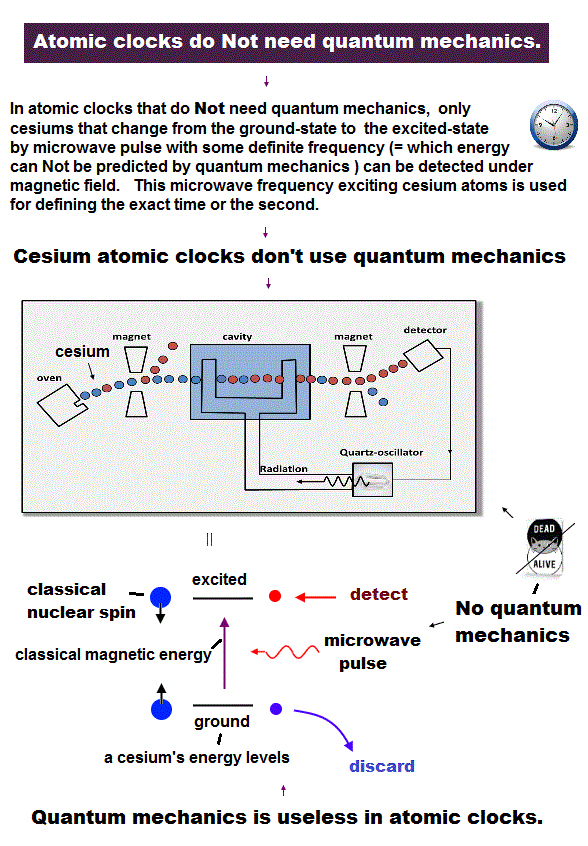
It is often said that atomic clocks in GPS (= which does Not use Einstein relativity ) needed quantum mechanics, which is untrue.
In atomic clocks, only cesium atoms which are excited to the upper hyperfine energy levels (= flipping classical nuclear spin magnetic moment ) by microwave pulse with some energy or frequency are deflected, collected and detected under magnetic field.
↑ When the number of these cesium atoms with the excited hyperfine state reaches a peak, the frequency of the microwave is used to define the exact standard of the time or the second for atomic clocks ( this-How does it all work? ).
This-3rd~4th-paragraphs say -- No quantum mechanics
"When a cesium atom receives microwave energy at exactly the right frequency, it changes its energy state."
"At the far end of the tube, another magnetic field separates out the atoms that have changed their energy state if the microwave field was at exactly the correct frequency.... This locked frequency is then divided by 9,192,631,770 to give the familiar one pulse per second required by the real world."
↑ As I said, quantum mechanics can Not predict nuclear spin nor hyperfine energy.
So quantum mechanics is completely useless and irrelevant to atomic clocks.
Quantum mechanics is completely useless in MRI, atomic clocks, all quantum sensors such as SQUID magnetic sensors, nitrogen-vacancy centers in diamond.

Feel free to link to this site.