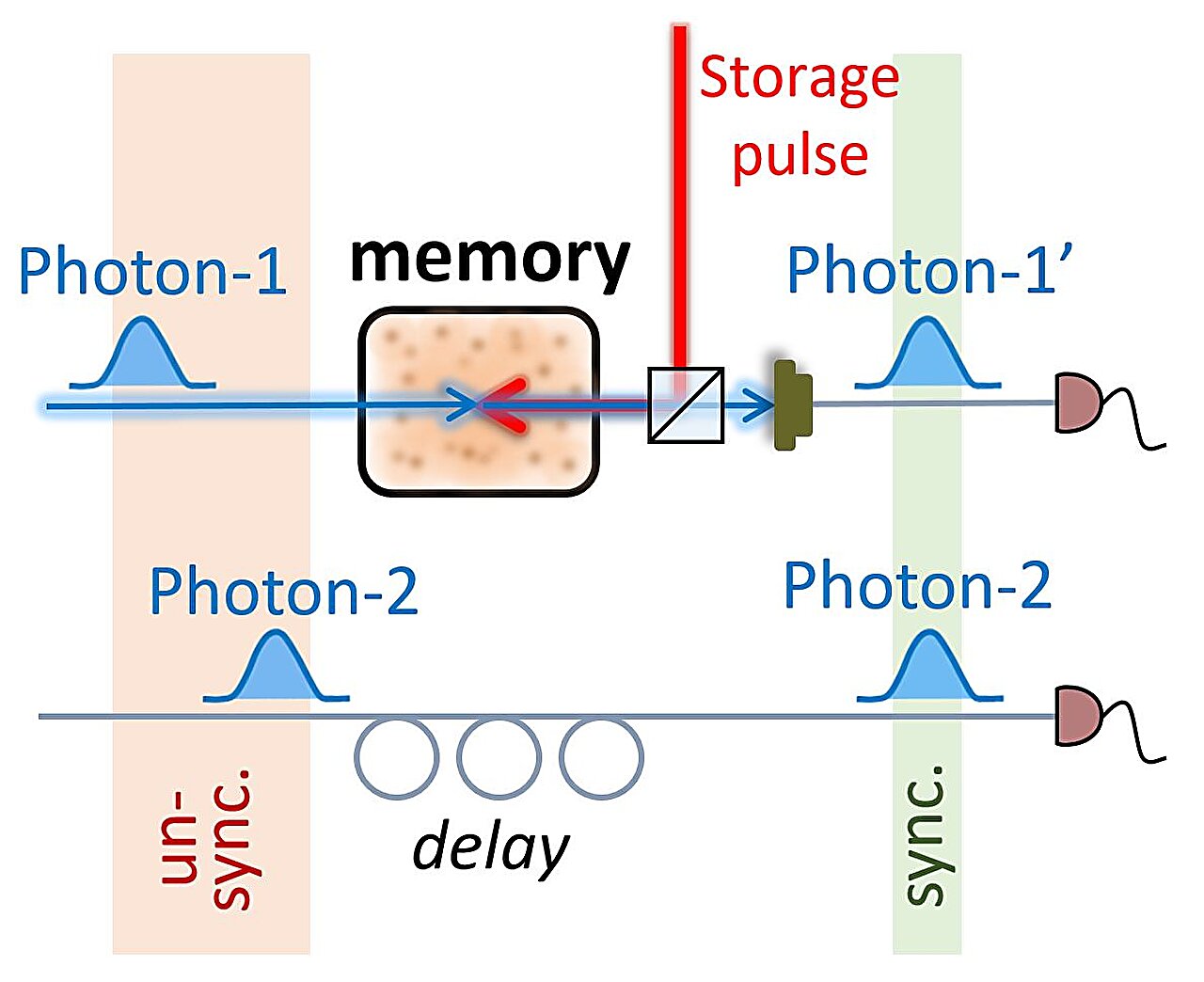
(Fig.1) Quantum memory is impractical, losing too many photons or quantum information
This-1st, 2nd paragraphs says -- Fragile quantum memory
"a quantum memory preserves a quantum state – which can be a superposition (= unseen, baseless ) of 0 and 1 at the same time"
"In practice, current quantum memories are far more fragile and short-lived than classical storage – they are fragile and error-prone compared to conventional memory."
A quantum memory is Not a real memory but just an atom storing weak light or a photon in its excited energy state ( this-p.3 ) for only a very short time, and losing almost all the stored photons.
This-challenges in quantum memory Storage time vs. communication needs says
" Even some solid-state memories in early experiments could store data only on the order of 100 milliseconds (= too short storage time to be a practical memory ) – after that, the qubit's state is effectively gone. This is nonpersistent compared to classical memory (which can hold data indefinitely until power is lost)."
The 7th paragraphs of this or this (4/2025) say -- store only 100ms
"Conversely, quantum memory can only store data for about 100 milliseconds (ms)." ← too short to be a practical memory.
This-p.2-left-2nd-paragraph-middle (5/2025) says -- Useless quantum memory
"repeaters also require high-performance
quantum memories which, despite years of impressive
progress, are still significant technological bottleneck for
practical implementations"
The 14th, 18th paragraphs of this hyped news (2024) about (still-impractical) quantum memory say
"A 'quantum dot' produced (non-entangled) photons (= just weak light ), which were then passed to a quantum memory system that stored the photons within a cloud of rubidium atoms." ← A quantum memory is just an atom storing photons or weak light as a excited energy state.
"The team will (= still do nothing ) now look to improve the system,... improving how long the photons can be stored (= today's impractical quantum memory can retain information for only too short time )"
↑ This research paper ↓
p.1-abstract says -- Quantum memory loses information
"We store
single photons from an indium arsenide quantum dot in a high-bandwidth rubidium vapor–based quantum
memory, with a total internal memory efficiency of 12.9 % (= losing 87.1% of all photons or stored information )."
This or this-p.2-Efficiency (η) says -- Too low memory efficiency
"The memory efficiency is ratio of probability of detecting the output photon
to that of the input photon ( this p.2-right-last )"
↑ This means even this recent quantum memory (= rubidium atom storing input photon quantum information as excited energy ) lost 87% of all the input photons or quantum information (= memory efficiency is just about 13% ).
So today's quantum memories losing almost all stored quantum information or photons with extremely low storing efficiency ( this p.4-left-results = two low storage efficiency. Their storing time is also impractically too short, only 800ps, this-p.3-right-3rd-paragraph ) is completely useless (forever).
The 5th, 2nd-last paragraphs of this hyped news (2025) say -- Memory = atoms
"demonstrated the heralded storage of photons in a Rydberg superatom (i.e., a cloud of atoms that behave as an individual quantum system under certain conditions = used as impractical quantum memory )."
"In the future (= still useless ), their proposed methods could contribute to the advancement and up-scaling of quantum networks."
↑ This paper's p.2-right-1st-paragraph says -- Useless quantum memory
"we reach an overall storage and read-out efficiency of
ηsr = 16.4% (= 83.6% information was lost ). After storing for about 670 ns (= impractically-short time memory )"
↑ Even this recent quantum memory consisting of atomic clouds lost 83.6% of all information (= absorbed light or photons ) due to low storage efficiency ( this-p.2-efficienty ).
↑ And this impractical atomic quantum memory could store photons or information for only very short time of 670ns, which can Not be used as a practical memory.
(Fig.2) Impractical quantum memory losing almost all information (= photon or weak light ) after storing it for too short time (= 25μs )
This hyped news (8/26/2025) ↓
4th-paragraph says -- Impractical quantum memory
"Future quantum computers and a quantum internet will (= still unrealized ) likewise require quantum memories (in particular, random-access quantum memories) to store and retrieve qubits...No single gold standard has yet emerged (= still impractical quantum memory )."
8th-paragraph says -- Atoms stored photons
"the team created an array of ten quantum memories by using a praseodymium-doped (= rare earth ) crystal cooled to 3 Kelvin inside a cryostat... each potentially storing a photon ( = weak light or photon is stored as
rare earth's
excited state in the useless
quantum memory )"
2nd-last-paragraph says -- Low-efficiency memory
"the next challenge will be to increase the performance (for example, in terms of efficiency and storage time)" ← still bad efficiency and too short storage time in quantum memory"
Last-paragraph says -- Still unrealized memory
"Overall, this study represents a significant step toward (= still unrealized ) the quantum equivalent of RAM, "
↑ This research paper ↓
p.2-Fig.1 shows quantum information (= weak light pulse or photons ) is stored into the rare earth (= Pr )'s excited state (= e ) transiently.
p.3-right-1st-paragraph says -- Bad memory efficiency
"..results in spin-wave memory efficiencies.. between 1.3 and
2.0% (= too-low, almost all information was lost, this-p.2-Efficiency ) for τ = 25μs.."
".. In summary, the total device efficiency of the multiplexed memory array.. with an average of 1.6% for a storage time of τ = 10μs and .. with an average of 0.6% for a storage time of τ = 25 μs."
↑ So almost all quantum information (= 99.4% of incident weak lights or photons ) was lost (= memory efficiency is just 0.6%, ) after storing them for just 25μs (= too short ! ).
↑ So the quantum memory, which loses almost all information after storing them for extremely short time (= μs ), is useless forever with No progress, contrary to hypes.
The 3rd, last paragraphs this hyped fake news (7/22/2025) say
"focused on a type of 2D material called van der Waals layered phosphochalcogenides..... Some ferroelectric materials are also magnetic, behaving similarly when a magnetic field is applied. That combination makes them ideal for advanced electronics like memory devices and sensors"
"The research is a major step forward (= still unrealized ), paving the way for materials that could change how engineers build electronics—from sensors for the military to longer-lasting laptops and tablets for students on the go." ← hyped fake news
↑ This research paper's abstract says nothing about any detailed practical application such as memory, sensors, laptops, contrary to the above hyped news.
↑ In this way, there is a wide discrepancy between the overhyped fake science news and the actual paper to hide today's deadend quantum mechanical researches.

Feel free to link to this site.