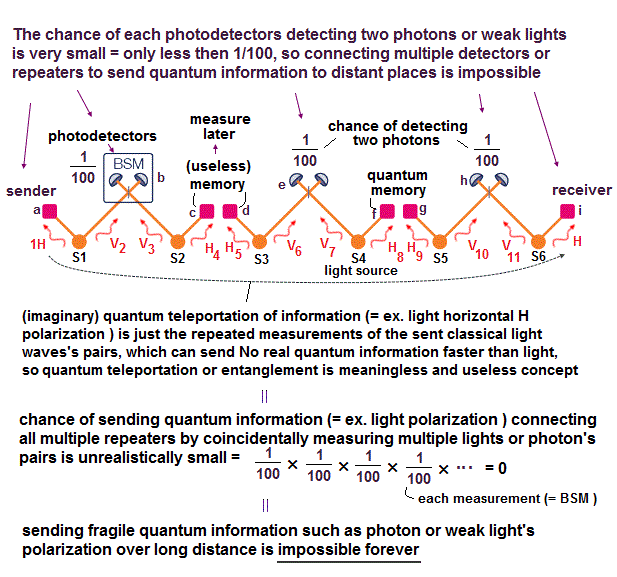
(Fig.1) Useless quantum repeater can only measure a pair of weak polarized lights (= fictitious photons ) with very low success rate, which cannot amplify nor send information over practically-long distance.
Quantum internet, communication, quantum key distribution (= QKD ) are useless forever, because they just repeat failed attempts to send fragile information (= very weak light or fictional photon), which is forbidden from being amplified, over long distance ( this 1st-paragraph ).
This 1st-paragraph says -- Useless quantum network
"Distributing quantum resources such as entanglement and qubits over long distance fibre optic networks represents an enormous challenge. If we send single photons over 1000km, even at rates of 10GHz, we would need to wait hundreds of years to detect just one (= one photon or information ), due to loss in the fibre. Not very practical !"
This p.1-left-1st-paragraph says -- Severe photon loss
"In QKD systems,
single-photon serves as the carriers of quantum keys,
which cannot be amplified and are easily scattered or
absorbed by the transmission channel"
Sending photons via expensive satellites is also useless, susceptible to a lot of background noise causing errors.
The only way of sending such a fragile quantum information over long distance is said to be a quantum repeater, but there are still No practical quantum repeaters despite extremely long years of fruitless researches ( this-p.2-left-2nd-paragraph, 2025 ).
This-p.46-2nd-last-paragrph (2026) says -- No quantum repeater
"Another critical challenge is the development of quantum repeaters,.. Quantum repeaters, which rely on entanglement swapping and quantum memory, are
still in the experimental stage, "
This-p.1-left-1st-paragarph (12/2025) says -- Useless quantum repeaters
"severely constrain both the achievable distance and the scalability of near-term quantum repeater
networks.
"
Quantum repeaters divide the path into multiple segments and put multiple light (= photon ) sources emitting pairs of polarized photons (= weak classical lights ), all of which related photons in all segments must be detected simultaneously (= or slightly delayed after being stored in useless quantum memory = QM losing photons ) by multiple photo-detectors called Bell state measurements (= BSM ) or linked with too low detection efficient due to severe photon loss.
↑ If they cannot measure all related photons emitted from all light sources in all quantum repeaters simultaneously (= or at exactly calculated times after storing them in quantum memory for a short time ), it fails to connect all photon information in all segments, and is likely to measure irrelevant wrong photons emitted at irrelevant times or noise.
↑ Each light source in each quantum repeater segment is programmed to emit a pair of weak classical light (= photons ) with some correlated (= illusory entangled ) polarizations, ex. both lights have the same polarizations (= vertical-vertical, or horizontal-horizontal ), or both lights have the opposite polarizations (= one light is vertically-polarized, the other light is horizontally-polarized ).
↑ Each photodetectors can only know whether two lights emitted from two different neighboring light sources have the same or opposite polarizations (= which light has horizontal or vertical polarization is unknown ) in its measurement (= BSM ) called entanglemt swapping.
↑ Based on results of measuring all photon pairs in all quantum repeaters' photodetectors simultaneously (= which is impossible, because photons of some repeaters in the long path are always lost, disconnecting a single light path and preventing a photon's information emitted by a sender from arriving at the receiver ), the receiver can estimate what quantum information (= photon's polarization ) was emitted from the sender in each photon.
So this quantum repeater can only measure pairs of weak classical lights (= fictional photons ) without amplifying nor sending them over long distance, which is called entanglement swapping ( this-Figure ).
This-p.9-2nd-paragraph says -- Just measuring photons
"the entangled photons can be emitted to a Bell
state measurement (= BSM ) station (= just detecting pairs of lights or photons at photodetectors ) to perform the entanglement swapping operation"
This-3rd-paragraph says -- Quantum repeater just measuring light
"Crucially, none of the intermediate nodes ever learn or copy the actual quantum data – they perform only quantum measurements (like Bell-state projections) "
The success rates of simultaneously detecting more pairs of photons by more photodetectors are much lower, when the path is more divided with more light sources, which is why quantum repeaters are impractical forever, unable to send quantum information over long distance after all.
This-p.1-left-last-paragraph says -- Quantum repeater losing photons
"For optical fiber-based quantum repeaters, the transmission between the repeater nodes decreases exponentially with distance"
Even the recent research ( this-lower, 3/26/2025 ) could send weak light or photon over only 50km by the impractical quantum repeater.
Quantum memories are also impractical, just losing more lights or information without storing them long enough.
This-p.1-left-last-paragraph (2025) says
"building quantum
repeaters remains a
significant
challenge"
This-middle-Looking ahead the road to 2030-2nd-paragraph (2024) says
"quantum
repeaters. The current state of these technologies poses significant
challenges for the practical realization"
This p.1-introduction-2nd-paragraph, p.2-2nd-paragraph (12/2024) say
"Long-distance (quantum) communication remains a significant challenge... As photons traverse fiber optic cables, losses become exponentially detrimental,.... these
repeaters have
yet to attain the
required technological maturity"
"Satellite communication, however, poses significant challenges, as they are costly to build, send to space and maintain. Their availability depends on weather and atmospheric conditions that are difficult to control"
This quantum repeater is also useless ( forever ), because the quantum repeater can Not amplify the weak light or photon information to send it over long distance.
The quantum repeater can just measure two polarized lights emitted from two different light sources (= between a sender and a receiver ) at the middle photodetectors (+ beam splitter ) called Bell state measurement (= BSM ).
In the upper figure, each of two different neighboring light sources sends a pair of lights (= ex. one is horizontally, the other is vertically-polarized, which is called entanglement = No quantum spooky action ) into the middle photo detectors and the sender (or receiver ).
↑ When the photodetectors measure a pair of lights to be vertically-polarized, it means other lights from the same light sources are horizontally-polarized lights, which is equal to sending the horizontally-polarized light (= photon quantum information ) from sender to receiver, which quantum repeater mechanism is called entanglement swapping ( this 5th-paragraph ).
The problem is the quantum repeaters have to rely on very-low success rate measurement of two polarized lights at the middle photodetectors simultaneously (= called coincidence detection, this p.4-1st-paragraph, this p.4-introduction ) to exclude irrelevant background lights or photons.
Quantum repeater = entanglement swapping = coincidence (= simultaneous ) detection of multiple photons at the same time by Bell-state measurement (= BSM ) with very low success rate ( this-A-Bell state measurement, this-p.10, this-p.4-left-last-paragraph ).
This p.2-left-2nd-paragraph says -- Photon coincident measurement
"entanglement swapping (= quantum repeater ) relies on fourfold coincidence (= detecting 4 photons simultaneously, this p.2-1.2 )"
To send the fragile quantum information (= photon or weak light ) over practically-long distance, they try to divide the whole path into many segments and use many quantum repeaters (= one repeater in one segment ) and measure many pairs of weak polarized lights emitted from many light sources (in all segments ) simultaneously (= with too low success rate ) by using many photodetectors on the way from the sender to the receiver.
↑ Based on results of measuring all related photon pairs (= related photons means photons measured simultaneously or at the exactly calculated times after being stored in quantum memory ) in all segments, the receiver can guess the initial photon's information of the sender.
This-lower-Challenges ahead says -- Quantum repeater losing photons
"Loss and Distance: Optical fiber has a fixed attenuation (~0.2 dB/km at 1550 nm). Quantum repeaters can leapfrog over loss, but each repeater node introduces its own loss and error probabilities"
Even today's best optical fiber loses fragile quantum information (= weak light or photons ) to just 1/10 in each 50km (= 0.2db/km, this-Figure.1 this-p.5-left ) where the initial photons decrease to just 1/10000 over 200km (= photons decrease to 1/100 over 100km = -20db, this-an example ).
↑ So even if they use multiple repeaters in each segment of 50km, it does Not change the fact that photons decrease to 1/10 (= probability of detecting a pair of photons is just 1/10 ) in each 50km, hence, the initial photons decrease to just 1/10000 (= 1/10 × 1/10 × 1/10 × 1/10 ) over just 200km by connecting all photons in all segments, which remains useless.
The actual probability of detecting two weak polarized lights (= two fictional entangled photons ) coincidentally at photodetectors in each quantum repeater segment is much lower, less than only 1/1000 over 50km (= lower than 1/10 ) due to massive photon loss. ↓
The 6th-paragraph of this (2023) says -- Photon loss, errors
"The obtained fidelity was 0.72 (= error rate was 28% = useless ), with nodes A and B obtaining entanglement (= by measuring two photons simultaneously ) with a success rate of 9.2 Hz (= very slow ) and a success probability of 9.2 × 10⁻⁴ per attempt ( over 50km )"
↑ Even the recent (useless) quantum repeater could connect only very short = 50km (= 25km × 2 ) distance by measuring two photons with very low success rate of just 9.2 × 10-4 = about 1/1000 (= 9.2Hz = sending and measuring only 9.2 photon pairs per second = too slow to be practical network ).
↑ Even the sent information or photons contained 28% errors, which cannot be used as reliable quantum key.
This other recent hyped research showed much lower two-photon coincidence probability (= measuring two photons simultaneously ) of only 8.5 × 10⁻⁶ ( this p.10(or p.2)-1st-paragraph ) over just 36km distance.
So the probability of sending the quantum information or photon over long distance by connecting multiple repeaters is almost zero = 0 = 1/1000 (= probability of measuring each pair of polarized lights in each quantum repeater's segment ) × 1/1000 × 1/1000 ...
This-p.1-Fig.1, p.2-Fig.2, p.3-left, Fig.3 showed -- Photon loss
Each entanglement swapping (= detecting pairs of lights from different sources ) for quantum repeater needed fourfold coincidences (= four photodetectors have to detect four different photons coincidentally with too low success rate ) in Bell state measurement, which was impractical, too slow, able to detect only less than 150 photons per 4000 seconds due to massive photon loss.
The easy loss of photons and too-low detection efficiency of multiple photons are why quantum repeaters cannot send quantum information over long distance, and practical quantum repeaters will be unrealized forever, as long as they try to use the fragile very weak light or photon as quantum information (= which is Not allowed to be amplified ) in vain.
Even in the latest researches in 2023 ~ 2024, the (still-impractical) quantum repeaters could connect points over only 35km ~ 50km due to severe photon (= information ) loss and a lot of errors, which was far from useful internet ( this last-paragraph ).
Quantum memory easily losing stored information is also impractical forever.

Feel free to link to this site.